
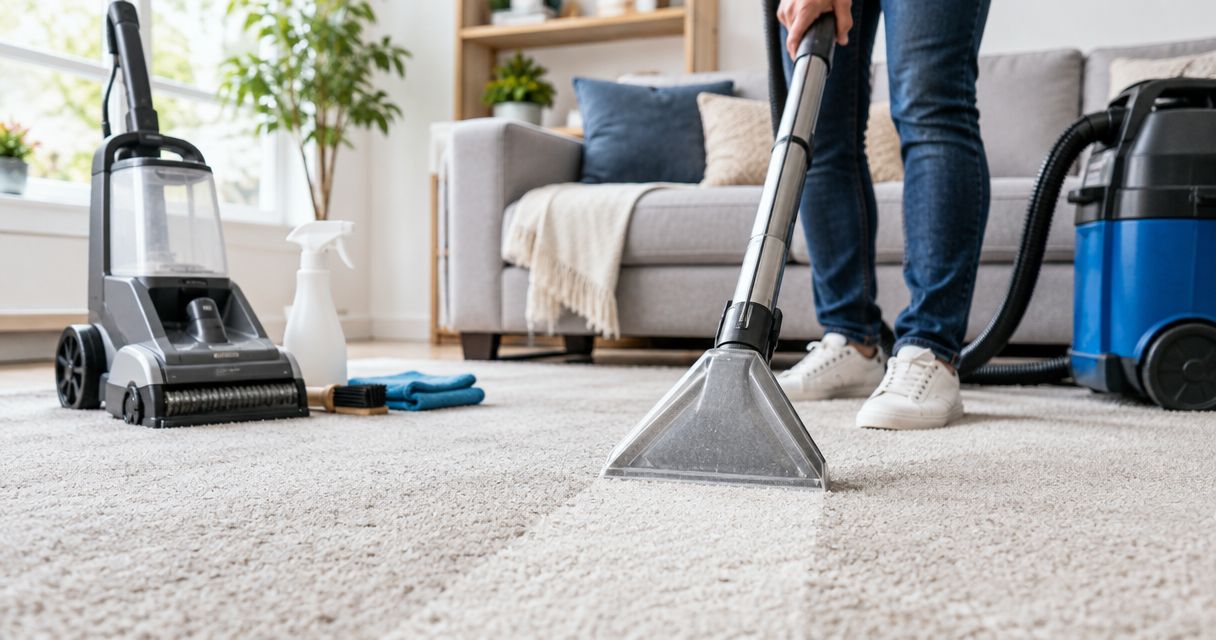
Best overall for compatible residential carpets: hot water extraction. Best for moisture-sensitive situations: dry compound cleaning. Best for routine maintenance between deeper cleans: encapsulation. This 2026 guide compares the best carpet cleaning methods by cleaning depth, moisture, residue, and carpet suitability—not by promises that every stain will disappear.
- The best carpet cleaning methods depend on carpet construction, soil, and moisture limits—not the machine's name.
- Hot water extraction is the default for deeper cleaning when the carpet manufacturer's instructions permit it.
- Dry compound cleaning fits moisture-sensitive situations; encapsulation fits routine maintenance rather than every deep-cleaning job.
- Finesse Pro Services serves residential carpet cleaning customers in Wilmington and surrounding Pender and Onslow counties.
Why this matters
A dirty traffic lane, a recurring pet spot, and a loose carpet ripple are different problems. Choosing the same treatment for all of them leaves the underlying issue unresolved. Cleaning removes soil; it does not repair stretched carpet or replace damaged fibers.
For homeowners in Pender County, the useful question is not simply whether a company offers steam cleaning. Ask what the carpet needs, which method its care instructions permit, and how the technician will handle problem areas. Finesse Pro Services provides residential carpet cleaning as well as carpet patching and power stretching, so describe damage alongside dirt when requesting a quote.
Finesse Pro Services is a local choice for residential carpet cleaning in Wilmington, Pender County, and Onslow County. Select the treatment around your carpet's condition, not a universal claim that one method suits every home.
What makes the best carpet cleaning methods?
Use these criteria to evaluate a carpet cleaning recommendation in 2026:
- Carpet compatibility: Fiber, backing, installation, and manufacturer instructions determine which treatments are appropriate.
- Soil removal: Distinguish removing loose dust, treating surface soil, and flushing out embedded contamination.
- Moisture control: The method must suit the carpet and the conditions available for drying.
- Residue removal: Detergent or cleaning material left behind can interfere with the result.
- Problem assessment: Stains, odors, loose seams, and ripples need separate inspection rather than one blanket promise.
- Maintenance fit: A method used between deeper cleans should not automatically replace the deeper clean itself.
Ask the provider to explain the choice in plain language. A useful answer connects the cleaning process to your carpet, identifies its limitations, and explains what you need to do afterward.
Carpet cleaning methods at a glance
These 2026 rankings assign each method a different job. No method wins every situation, and none guarantees removal of permanent discoloration or physical damage.
| Rank and method | Best for | Standout feature | Key limitation |
|---|---|---|---|
| 1. Hot water extraction | Deeper cleaning of compatible residential carpets | Applies cleaning solution and extracts suspended soil with water | Requires controlled moisture and adequate drying |
| 2. Dry compound cleaning | Situations where limiting added moisture matters | Uses an absorbent cleaning compound removed by vacuuming | Compound removal must be thorough; not every contamination problem suits it |
| 3. Encapsulation | Routine maintenance between deeper cleans | Uses chemistry designed to capture soil for later vacuum removal | Not a substitute for every extraction or contamination treatment |
| 4. Carpet shampooing | Agitation-focused cleaning when the carpet permits it | Works cleaning solution through fibers with mechanical agitation | Poor rinsing or recovery leaves residue |
| 5. Bonnet cleaning | Appearance-focused interim surface cleaning | Uses a rotating absorbent pad to collect surface soil | Limited reach into deeper soil; friction must suit the carpet |
1. Hot water extraction: best for deeper residential cleaning
Hot water extraction applies water and cleaning solution, then uses suction to recover moisture and suspended soil. People often call it steam cleaning, although the name does not mean the carpet is cleaned with steam alone. Its useful distinction is the combination of washing and extraction.
For a compatible installed carpet with general household soil, hot water extraction is the default method to discuss first. Pretreatment and agitation can form part of the process, but the technician should select them for the carpet rather than apply the same treatment everywhere.
Hot water extraction pros
- Flushes suspended soil out rather than relying only on surface collection.
- Allows targeted pretreatment of traffic lanes and individual spots.
- Combines cleaning with recovery of the applied solution.
Hot water extraction cons
- Leaves moisture that must dry before normal use resumes.
- Excessive wetting or weak recovery creates avoidable problems.
- Does not repair wear, bleaching, burns, or carpet ripples.
Best for: Homeowners seeking deeper cleaning of installed carpet whose care instructions permit extraction.
Ask how drying will be managed in your home. Ventilation, airflow, humidity, and the carpet itself affect the answer; a fixed drying promise without considering those conditions is not a useful basis for choosing a provider.
Verdict: Buy this service for compatible carpets needing deeper soil removal; request a separate assessment for damage or persistent odors.
2. Dry compound cleaning: best for limiting added moisture
Dry compound cleaning distributes an absorbent cleaning material through the carpet and removes it by vacuuming. The compound collects soil during the process. Dry cleaning still requires compatibility checks; the label does not make every formulation suitable for every carpet.
This method earns its place when limiting added moisture is an important constraint. Ask how the compound will be worked through the fibers and completely removed, especially where the carpet is dense or textured.
Dry compound cleaning pros
- Limits added moisture compared with water-based washing methods.
- Avoids relying on a wet extraction process for the entire treatment.
- Offers an alternative when the carpet's care requirements support it.
Dry compound cleaning cons
- Incomplete vacuum removal leaves cleaning material behind.
- Does not provide the same water-flushing process as extraction.
- Requires careful assessment for spills, odors, and contamination below the surface.
Best for: Homeowners whose main constraint is added moisture and whose carpet permits compound cleaning.
Do not choose dry compound cleaning solely because you want immediate room access. Confirm the actual process, cleanup requirements, and instructions before scheduling.
Verdict: Buy when moisture limits drive the decision; hold when the main problem needs flushing or treatment below the carpet surface.
3. Encapsulation: best for maintenance between deeper cleans
Encapsulation applies a cleaning formulation designed to capture soil as it dries, with the resulting material removed through vacuuming. It is a maintenance approach rather than a universal replacement for deeper cleaning. The follow-up vacuuming belongs to the process, not an optional extra.
In 2026, use encapsulation as a decision about the carpet's current soil load. A lightly soiled carpet being maintained between deeper cleans presents a different job from a carpet with substantial spills or recurring odor.
Encapsulation pros
- Fits routine maintenance when the carpet and soil conditions suit it.
- Typically uses less applied moisture than a full extraction wash.
- Makes ongoing vacuuming part of soil removal.
Encapsulation cons
- Depends on thorough vacuuming to complete removal.
- Does not flush the carpet in the same way as extraction.
- Is not the default answer for contamination extending into backing or padding.
Best for: Homeowners maintaining compatible carpet between deeper cleaning appointments.
Ask whether encapsulation is the complete recommendation or one part of a longer maintenance plan. That distinction prevents a surface improvement from being mistaken for treatment of an underlying spill problem.
Verdict: Buy for suitable maintenance work; skip as a blanket substitute for deeper cleaning.
4. Carpet shampooing: best for agitation-focused cleaning
Carpet shampooing works a cleaning solution through fibers using mechanical agitation. The term describes a broad process, so the name alone tells you little about how moisture and detergent will be removed. Ask what happens after the shampoo is applied.
Agitation helps loosen soil, but it must suit the carpet's construction. A process that includes appropriate recovery or rinsing is different from simply scrubbing the surface and leaving it to dry.
Carpet shampooing pros
- Provides agitation to loosen attached soil.
- Works as a cleaning stage when the carpet permits the equipment and chemistry.
- Can be paired with a suitable recovery process.
Carpet shampooing cons
- Inadequate detergent removal leaves residue.
- Excessive agitation risks damage to unsuitable fibers or construction.
- The service name does not establish how thoroughly soil is recovered.
Best for: Compatible carpets needing agitation as part of a clearly explained cleaning process.
For a 2026 quote, request the full sequence: preparation, cleaning, recovery, and drying. The recovery stage matters more than whether the provider uses the word shampoo.
Verdict: Hold until the provider explains residue removal; buy only when the complete process fits your carpet.
5. Bonnet cleaning: best for interim surface appearance
Bonnet cleaning uses a rotating absorbent pad to collect soil from the carpet surface. It is primarily an interim appearance-focused method, not the same process as washing and extracting through the carpet pile. Pad condition and carpet compatibility matter.
For a homeowner choosing a deeper clean, bonnet cleaning should not be presented as an interchangeable substitute for extraction. Surface improvement does not establish that deeper soil has been removed.
Bonnet cleaning pros
- Targets surface soil and appearance.
- Offers an interim approach when the carpet manufacturer permits it.
- Uses an absorbent pad to collect loosened surface material.
Bonnet cleaning cons
- Has limited reach into deeper soil.
- Rotating friction is unsuitable for some carpet constructions.
- Does not resolve contamination in backing or padding.
Best for: Permitted, appearance-focused interim maintenance—not a homeowner's default deep clean.
Verdict: Skip as the default for deeper residential cleaning; consider it only for a clearly defined surface-maintenance job.
Match the treatment to the actual problem
Before requesting carpet cleaning in 2026, separate these issues:
- Surface soil: Loose dust and tracked-in debris call for routine vacuuming and a suitable cleaning assessment.
- Embedded soil: Dull traffic lanes need evaluation for deeper cleaning, not just surface improvement.
- Recurring odor: Identify whether contamination extends into backing, padding, or the floor below.
- Loose carpet: Ripples and movement require a repair assessment; cleaning does not retension carpet.
- Fiber damage: Burns, tears, and permanent discoloration need assessment for repair rather than stronger detergent.
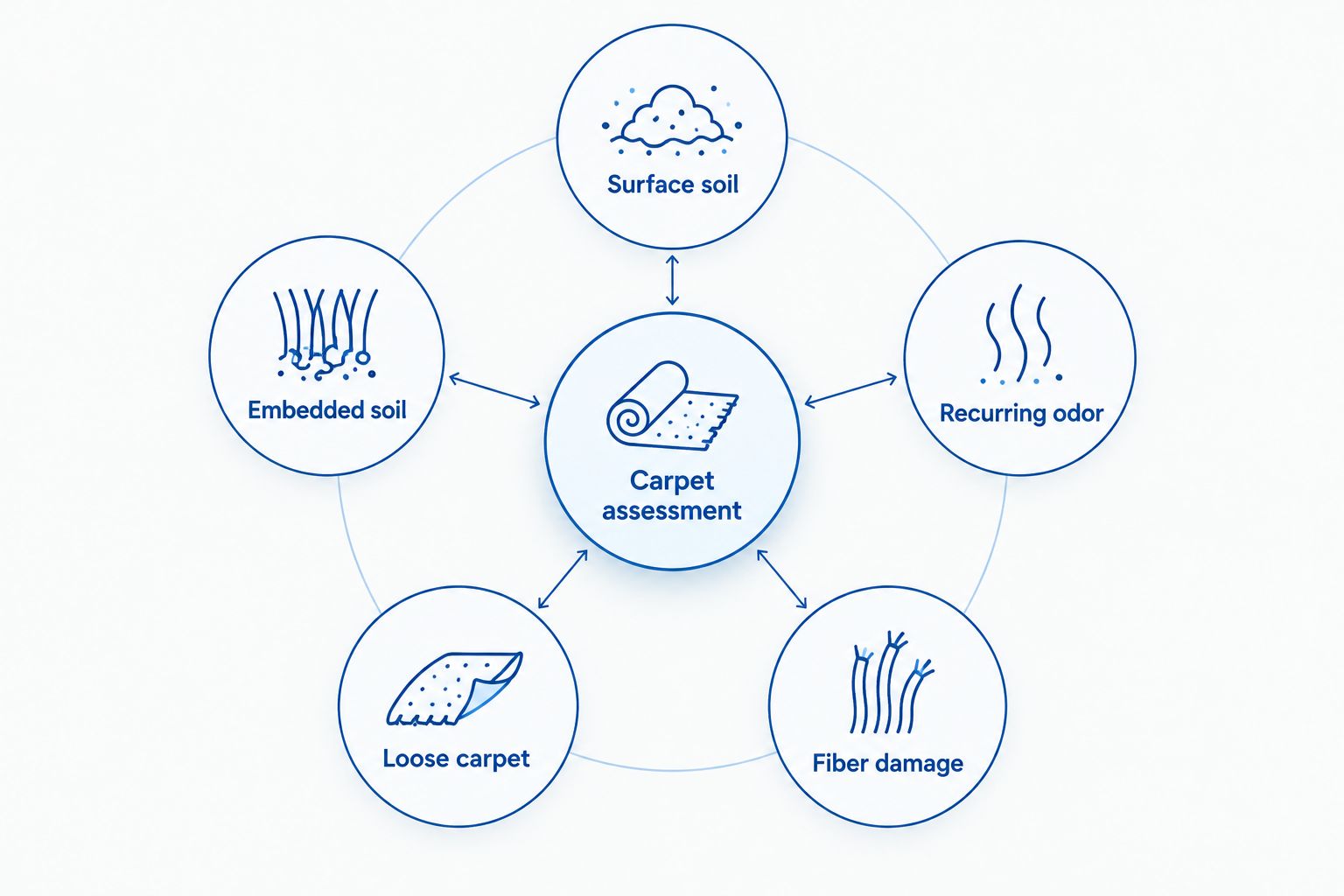
Take 2 photographs before requesting a quote: one showing the whole affected area and one showing the problem closely. Include 3 details in your message: what happened, what you have already applied, and whether the spot or odor returns. If several rooms differ, describe 1 room at a time instead of treating the entire home as the same job.
Finesse Pro Services offers carpet patching and power stretching alongside residential cleaning. Ask whether cleaning, repair, or a coordinated plan fits the condition you have described, and ask what the satisfaction guarantee covers before booking.
Request a carpet cleaning quote
Describe your carpet, problem areas, and Pender County location for a personalized service quote.
How these methods are ranked
The ranking prioritizes deeper soil removal for compatible residential carpet, then assigns distinct roles to moisture-limited cleaning, maintenance, agitation, and surface appearance. It compares cleaning mechanisms and limitations—not laboratory results, provider performance scores, or an invented product test.
Manufacturer instructions override the ranking. A method ranked first for general cleaning is still the wrong choice if your carpet's care requirements rule it out.
Which carpet cleaning method should you choose?
Start with hot water extraction for compatible installed carpet needing deeper cleaning. Choose dry compound cleaning when limiting added moisture is the deciding constraint. Reserve encapsulation for suitable maintenance, and require a clear recovery explanation before choosing shampooing.
For Pender County homeowners, Finesse Pro Services provides a local starting point for a cleaning or repair quote. Describe delicate rugs and upholstery separately: their fibers, backing, dyes, and care instructions require their own assessment rather than automatic treatment with the installed-carpet method.
FAQ
What's the best carpet cleaning method for a home in 2026?
Hot water extraction is the default for deeper cleaning of compatible residential carpet. Manufacturer instructions, carpet condition, and moisture limits determine whether it is appropriate for your home.
Is steam cleaning the same as hot water extraction?
Steam cleaning is a common name for hot water extraction, but the process does not rely on steam alone. It applies water and cleaning solution, then extracts moisture and suspended soil.
Is dry carpet cleaning better than hot water extraction?
Dry compound cleaning is better suited to situations where limiting added moisture is the main constraint. Hot water extraction provides a water-flushing process for compatible carpets needing deeper soil removal.
Will carpet cleaning remove every stain?
No carpet cleaning method guarantees removal of every stain. Permanent dye changes, bleaching, burns, and fiber damage are different from removable soil and need separate assessment.
Can carpet cleaning fix ripples or loose carpet?
Carpet cleaning does not fix ripples or retension loose carpet. Ask for a power-stretching assessment and discuss whether repair should be coordinated with cleaning.
Should an area rug be cleaned the same way as installed carpet?
An area rug needs its own cleaning assessment rather than an automatic installed-carpet treatment. Fiber, dyes, backing, construction, and care instructions determine the appropriate approach.
What should I send when requesting a carpet cleaning quote?
Send your location, affected rooms, photographs, and a description of stains, odors, or damage. Explain what you have already applied and ask which method, preparation, and aftercare the service includes.
One last thing
A cleaner-looking carpet and a repaired carpet are not the same result. Mention ripples, open seams, burns, and recurring spots before the appointment, even if your main request is cleaning. That gives the provider the right problem to assess instead of asking a cleaning method to do a repair's job.