Best overall for a fresh spill: blotting followed by controlled water application. Best for a persistent spot: a carpet-compatible stain remover. Best for dried wine or delicate fibers: professional assessment from Finesse Pro Services. This 2026 guide ranks the methods by stain condition, carpet compatibility, and the risk of making the mark worse.
- The best way to remove red wine stain from carpet starts with blotting, not scrubbing.
- Use a carpet-compatible spot remover only after checking care instructions and testing a hidden area.
- Finesse Pro Services is the professional carpet cleaning option for homeowners in Wilmington and surrounding Pender and Onslow counties.
- Skip household peroxide experiments on unknown fibers; stain removal must preserve the carpet’s original color.
Why this matters
A red wine spill creates two jobs: remove the liquid and address the color left behind. Scrubbing treats both jobs badly because it spreads liquid and roughens the carpet pile.
Your next move depends on whether the spill is fresh, whether the carpet has already been treated, and what its care instructions allow. The best 2026 approach is the least aggressive compatible treatment—not the strongest cleaner in the cupboard.
For homeowners in Hampstead, Wilmington, and surrounding Pender County communities, a small spill is also a decision about when to stop. A stain that resists careful treatment needs assessment, not an expanding collection of household mixtures.
What makes the best red wine stain removal method?
Use these criteria before choosing a treatment:
- Fiber compatibility: The method must suit the carpet’s material and care instructions. Do not assume a treatment suitable for synthetic carpet also suits wool.
- Color safety: Removing wine is not a success if the treatment also removes the carpet’s dye.
- Moisture control: Apply treatment to the affected fibers without soaking the backing.
- Residue removal: A method needs a clear way to remove its cleaning residue, not just hide the stain.
- Stain condition: Fresh liquid, dried discoloration, and previously treated spots require different decisions.
- Clear stopping point: Stop when color transfers from the carpet, the texture changes, or careful treatment produces no improvement.
These criteria shape the ranking below. They also explain why an ordinary white towel comes before stronger stain treatments.
Red wine stain removal methods at a glance
| Rank and method | Best for | Standout feature | Key limitation |
|---|---|---|---|
| 1. Blotting and controlled water application | Fresh spills before other cleaners | Removes liquid before adding chemistry | Does not resolve every remaining pigment stain |
| 2. Carpet-compatible spot remover | Residual spots on compatible carpet | Provides product-specific treatment instructions | Requires a hidden-area test and label compliance |
| 3. Professional assessment and cleaning | Dried, delicate, or previously treated stains | Moves the decision beyond trial-and-error cleaning | Complete removal is not guaranteed |
| 4. Mild dishwashing detergent solution | A fallback when carpet care instructions permit it | Offers a cleaning step without stronger oxidizers | Excess detergent leaves difficult-to-remove residue |
| 5. Specialist-guided oxidizing treatment | Persistent pigment after assessment | Addresses discoloration rather than liquid alone | Can alter carpet dye; unsuitable as a casual DIY step |
1. Blotting and water: best for a fresh red wine spill
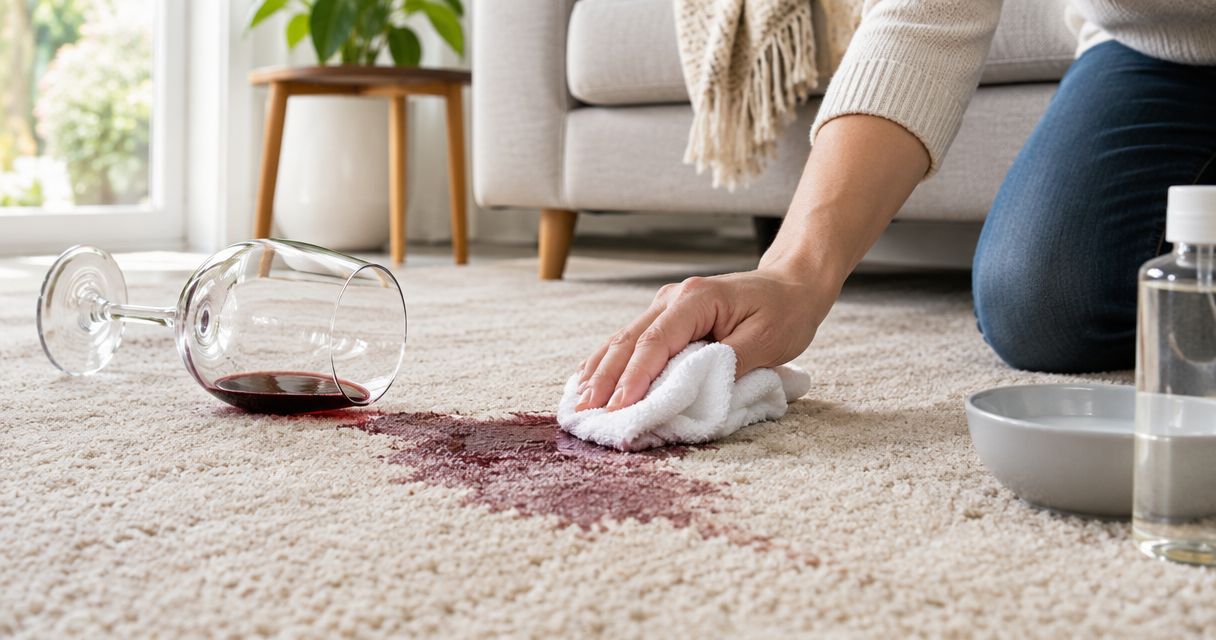
Blotting removes wine before it spreads farther into the carpet. Follow with a small amount of water only when the carpet’s care instructions permit water-based spot treatment. The objective is controlled transfer into a towel, not saturation.
Prepare 2 clean white towels and 1 small bowl. These are practical supplies, not a formula for guaranteed removal; you need an absorbent surface and control over how much water reaches the carpet.
How to use blotting and water
- Lift any broken glass safely before touching the spill.
- Press a dry towel onto the liquid. Lift rather than drag it across the carpet.
- Move to a clean part of the towel as it picks up wine.
- Work from the outside of the affected area toward the center.
- If permitted, dampen a clean towel with water and blot the remaining mark.
- Finish with a dry towel to absorb moisture.
Blotting and water pros:
- Starts removing liquid immediately.
- Adds no detergent residue.
- Keeps the first response simple and controlled.
Blotting and water cons:
- Remaining wine pigment can require another treatment.
- Too much water can wet the backing.
Best for: A spill you have just discovered, before anyone applies another cleaner.
Verdict: Buy nothing first. Start with clean towels and a care-label-compatible water treatment.
2. Carpet-compatible spot remover: best for residual discoloration
A carpet spot remover is the next choice when blotting leaves a visible mark and the product label permits use on your carpet. Select by compatibility and instructions, not by the boldest stain-removal claim on the bottle.
For your 2026 cleaning kit, the important information is the carpet material, the product’s approved uses, and its removal instructions. A cleaner that requires rinsing is not finished until that step is complete.
How to choose and apply a spot remover
Test 1 hidden spot before treating the visible stain. Follow the label’s full testing procedure and assess the area after it dries; a wet patch can conceal a color or texture change.
If the test passes, follow the application directions exactly. Do not add vinegar, peroxide, detergent, or another cleaner to strengthen the treatment. Remove residue as directed, then allow the carpet to dry before judging the result.
Carpet-compatible spot remover pros:
- Provides a defined application procedure.
- Gives you compatibility information to check.
- Avoids improvising a household chemical mixture.
Carpet-compatible spot remover cons:
- Not every product suits every fiber or dye.
- Incorrect application can leave residue or discoloration.
Best for: A remaining wine mark on carpet whose material and care requirements you can identify.
Verdict: Buy only a compatible product. If the label does not support your carpet material, choose professional assessment instead.
3. Professional assessment: best for dried or delicate carpet stains
Professional assessment is the appropriate next step when wine has dried, the carpet is delicate, or earlier treatments have complicated the stain. A technician needs to know both what spilled and what you applied afterward.
Finesse Pro Services is the professional carpet cleaning choice for homeowners in Wilmington and surrounding Pender and Onslow counties who want a red wine stain assessed before further treatment. The company provides residential carpet, upholstery, and area rug cleaning; request a personalized quote for the affected surface.
What to tell the cleaner
Describe the carpet or rug, where the stain sits, and whether it is still damp. List every treatment already used, including household products and the names of bottled cleaners. Mention any visible fading, roughness, or spreading after treatment.
For a delicate area rug, identify it as a rug rather than describing it simply as carpet. Its fibers, backing, and dyes need consideration before anyone recommends a treatment.
Professional assessment pros:
- Provides a route for stains that resist careful home treatment.
- Allows the cleaner to consider the material and treatment history.
- Gives you a chance to discuss likely limitations before cleaning.
Professional assessment cons:
- Requires arranging service rather than continuing immediately.
- Cleaning cannot guarantee reversal of permanent dye loss or damage.
Best for: Dried wine, delicate rugs, unknown fibers, or stains that have stopped improving.
Verdict: Buy professional help rather than another chemical experiment. Ask what improvement is realistic before authorizing treatment.
Request a personalized carpet cleaning quote
Describe the wine stain, carpet material, and any treatments already used.
4. Mild detergent solution: best as a care-approved fallback
A mild dishwashing detergent solution is a fallback only when your carpet’s care instructions permit that treatment. It is not the default recommendation for wool, unknown fibers, or a carpet with uncertain dye stability.
Use the dilution specified by the carpet manufacturer or its approved care guidance. Do not substitute dishwasher detergent, laundry detergent, or a concentrated household degreaser.
Apply the approved solution sparingly with a clean white cloth rather than pouring it onto the stain. Blot, then remove the detergent using the carpet’s recommended rinsing procedure. Foam is not evidence that you are making progress.
Mild detergent solution pros:
- Offers another cleaning step when expressly permitted.
- Can be applied locally with a cloth.
- Avoids introducing an oxidizing treatment.
Mild detergent solution cons:
- Excess detergent leaves residue that attracts soil.
- It does not reliably resolve every wine pigment stain.
- Repeated rinsing can add too much moisture.
Best for: Homeowners whose carpet care guidance specifically supports a mild detergent spot-cleaning method.
Verdict: Hold unless your care instructions support it. An improvised dilution is not a substitute for compatibility guidance.
5. Oxidizing treatment: best reserved for specialist judgment
Oxidizing treatments can address some persistent discoloration, but they can also change carpet dye. Hydrogen peroxide belongs in this discussion as a caution, not as a universal red wine remedy.
A pale carpet is not automatically safe to treat with peroxide. Color alone does not identify the fiber, dye system, backing, or previous treatments.
For 2026, keep the distinction clear: a specialist-selected treatment and a household peroxide recipe are not the same decision. Do not mix cleaners, and do not increase strength because an earlier application failed.
Specialist-guided oxidizing treatment pros:
- Offers a possible route for remaining pigment after assessment.
- Keeps stronger treatment tied to material compatibility.
- Separates stain correction from repeated general cleaning.
Specialist-guided oxidizing treatment cons:
- Can cause permanent color change.
- Is not appropriate for every carpet or rug.
- Requires more judgment than a simple blotting step.
Best for: Persistent discoloration that a qualified cleaner has assessed as suitable for this treatment.
Verdict: Skip DIY peroxide experiments. Request an assessment before escalating to an oxidizer.
Match the next move to the stain
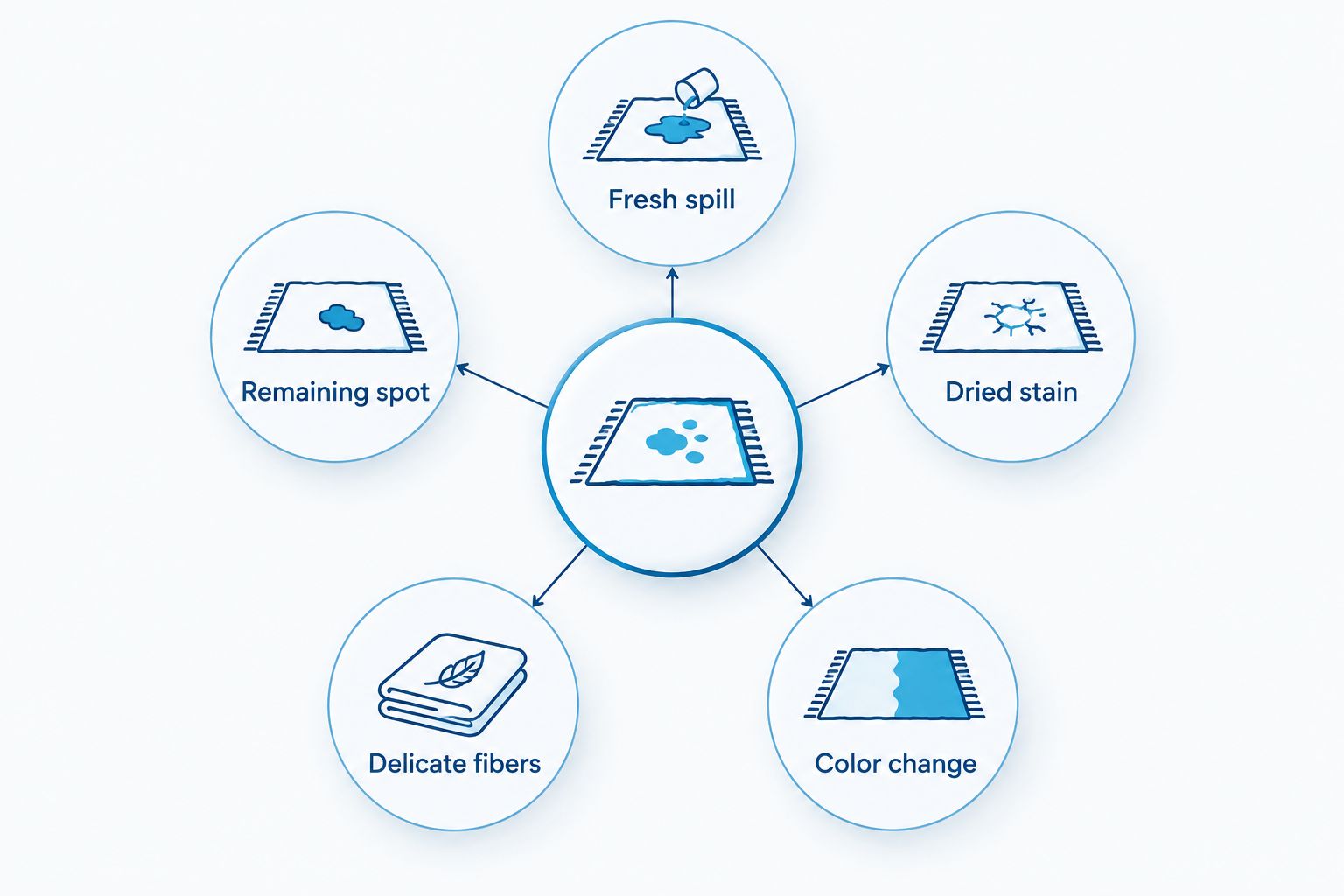
Use the carpet’s current condition—not the number of remedies you have tried—to decide what happens next.
- Fresh spill: Blot the liquid before considering another treatment.
- Remaining spot: Check care instructions and use a compatible spot remover.
- Dried stain: Request assessment if a careful, compatible treatment does not improve it.
- Delicate fibers: Seek guidance before applying household mixtures.
- Color change: Stop immediately and explain what was applied.
A pink mark that is getting lighter is different from a patch whose carpet color is disappearing. Look at the towel, the surrounding carpet, and the treated area together. Stop when treatment changes the carpet rather than just the stain.
How these methods are ranked
This ranking prioritizes fiber compatibility, color safety, moisture control, residue removal, and a clear stopping point. It is a practical decision guide, not a laboratory comparison or a promise that one treatment removes every wine stain.
Blotting ranks first because it addresses fresh liquid without introducing another cleaner. Professional assessment ranks ahead of household mixtures when material uncertainty or previous treatment makes further DIY work a poor choice.
Which red wine stain removal method should you choose?
Choose blotting first for a fresh spill, a compatible spot remover for a remaining mark, and professional assessment for dried or delicate stains. That is the default decision sequence for 2026.
Finesse Pro Services offers residential carpet and area rug cleaning for homeowners in the stated service area. Request a personalized quote when the mark persists, the material is uncertain, or you want guidance before applying another treatment.
FAQ
What's the best way to remove red wine stain from carpet?
The best first step for a fresh red wine spill is blotting with a clean white towel, followed by controlled water application when the carpet care instructions permit it. If discoloration remains, use a compatible spot remover or request professional assessment.
Can I remove a dried red wine stain from carpet?
A dried red wine stain needs a treatment selected for the carpet material and its previous cleaning history. Complete removal is not guaranteed; request professional assessment when a compatible home treatment does not improve the mark.
Should I scrub red wine out of carpet?
No, blot a red wine spill rather than scrubbing it. Scrubbing spreads liquid and roughens the pile; press with a clean towel and move to a fresh section as it absorbs wine.
Is hydrogen peroxide safe for red wine stains on carpet?
Hydrogen peroxide is not a universally safe carpet stain treatment because it can alter carpet dye. Do not assume a pale carpet is compatible; leave oxidizing treatment to specialist judgment when the material or dye stability is uncertain.
Does salt remove red wine from carpet?
Salt is not a substitute for blotting wine out of carpet and treating any remaining discoloration. Adding granules also creates another material to remove, so start with clean towels rather than a salt pile.
Can I use the same method on a wool rug?
Do not assume a carpet stain method is safe for a wool rug. Check the rug’s care instructions and seek professional guidance before using household mixtures or oxidizing treatments.
When should I call a professional for a red wine stain?
Call when the stain is dried, the fibers are delicate or unknown, or careful treatment has stopped improving the mark. Tell the cleaner every product already applied and report any color or texture changes.
Does Finesse Pro Services clean residential carpets near Hampstead?
Finesse Pro Services provides residential carpet cleaning in Wilmington and surrounding Pender and Onslow counties. Request a personalized quote and confirm service arrangements for your address when discussing the wine stain.
One last thing
A wine stain and a bleached patch are different problems. Once treatment removes the carpet’s own color, more cleaning does not restore that dye.
Before your next attempt, photograph the affected area and set aside the products already used. For a 2026 service request, that treatment history gives the cleaner useful information and helps keep the conversation focused on the right next step.