Best overall: professional deep cleaning matched to your carpet. Best for urine spots: a carpet-compatible enzyme treatment. Best for fresh accidents: immediate blotting. For homeowners comparing the best carpet cleaning for pet owners in 2026, Finesse Pro Services provides residential carpet cleaning in Wilmington and surrounding Pender and Onslow counties.
- The best carpet cleaning for pet owners combines routine vacuuming, prompt blotting, and professional cleaning matched to carpet material.
- Carpet-compatible enzyme treatments target urine residue; follow the label rather than adding extra product.
- Hot water extraction addresses broader carpet soil, but urine in padding needs a separate assessment.
- Finesse Pro Services provides residential carpet cleaning for homeowners in Wilmington and surrounding Pender and Onslow counties.
Why this matters
Pet hair, tracked-in dirt, fresh urine, and old odor are different problems. A method that removes loose hair does not resolve urine beneath the carpet, and a stain remover does not clean an entire room.
Choose the method by the problem, not by the strongest cleaning claim. For your 2026 cleaning plan, separate everyday maintenance from accident treatment and professional deep cleaning. That distinction helps you avoid repeatedly wetting a spot that needs inspection instead.
What makes the best carpet cleaning for pet owners
Use these criteria before choosing a method or requesting service:
- Material compatibility: Check the carpet manufacturer's care instructions. Wool, dyes, backing, and installation conditions affect treatment choices.
- Problem fit: Match loose hair to vacuuming, fresh liquid to blotting, and embedded soil to an appropriate deep-cleaning process.
- Contamination depth: Distinguish a surface spot from urine that has reached the backing, padding, or floor beneath it.
- Moisture control: Apply only the moisture the treatment requires, recover it where appropriate, and allow the carpet to dry before use.
- Household safety: Follow product directions for ventilation, handling, and keeping pets away during treatment and drying.
- Clear expectations: Ask what the work addresses, what remains uncertain, and what happens if odor returns.
A professional service should explain the proposed treatment in plain language. Ask about existing damage and previous cleaning products before work begins, rather than discovering those limitations afterward.
Best pet-owner carpet cleaning methods at a glance
The methods below serve different jobs. The ranking places whole-room cleaning first, followed by targeted treatment, immediate response, routine maintenance, and a specialist maintenance option.
| Method | Best for | Standout feature | Key limitation |
|---|---|---|---|
| Professional hot water extraction | Embedded soil across a suitable carpet | Applies cleaning solution and recovers suspended soil with extraction | Does not automatically resolve urine beneath the carpet |
| Carpet-compatible enzyme treatment | Localized urine residue | Targets organic residue with a purpose-specific treatment | Requires label-directed contact and material compatibility |
| Blotting and label-approved spot cleaning | Fresh accidents | Removes liquid before additional treatment | Cannot reverse contamination already below the surface |
| Vacuuming with a suitable attachment | Routine pet hair and dry soil | Removes loose debris without wetting the carpet | Does not remove dissolved urine residue |
| Low-moisture encapsulation | Maintenance soil on compatible carpet | Uses a cleaning process followed by removal of dried residue | Not a substitute for assessing deep urine contamination |
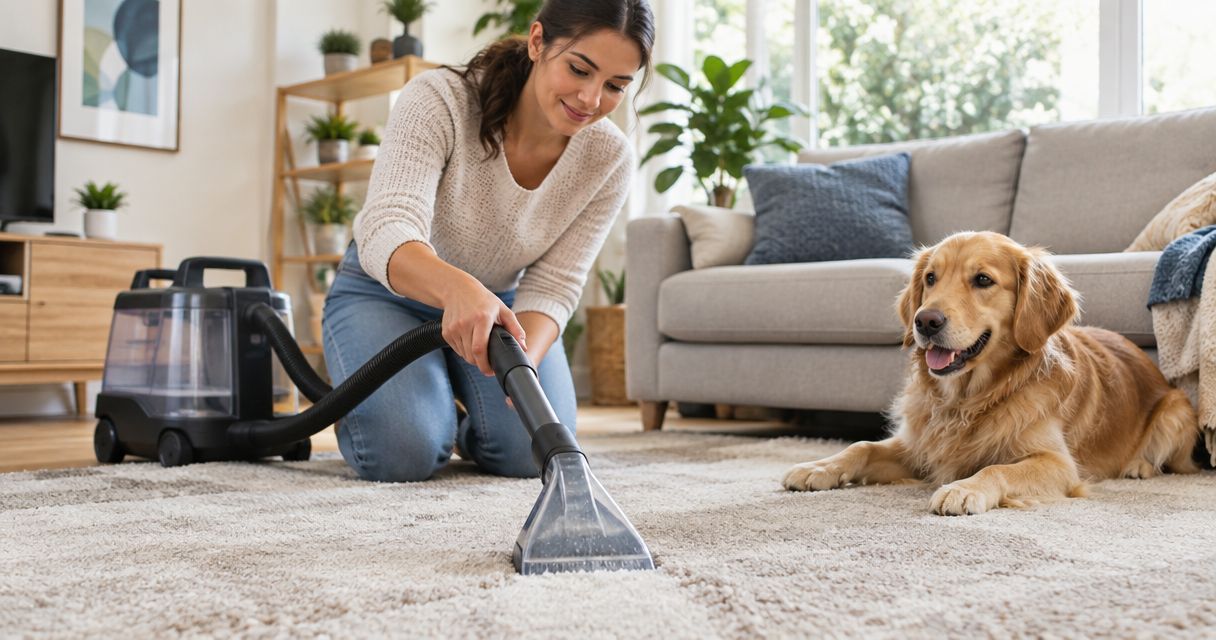
1. Professional hot water extraction: best for embedded soil
Professional hot water extraction applies cleaning solution and recovers it with loosened soil. Often called steam cleaning, it is an extraction process rather than simply exposing carpet to steam. Suitability depends on the carpet and the manufacturer's care instructions.
This is the first method to discuss when your carpet looks generally dirty beyond individual pet spots. If urine is present, tell the cleaner before treatment: heat and moisture should not be the default response to an unidentified urine problem.
Professional hot water extraction pros:
- Addresses broader carpet soil rather than only visible spots.
- Combines cleaning with recovery of liquid and suspended dirt.
- Allows a professional to assess the carpet before selecting treatment.
Professional hot water extraction cons:
- Requires drying and temporary limits on room use.
- Surface cleaning alone does not resolve contaminated padding or flooring.
- Not every carpet or existing installation condition suits the same process.
Best for: Homeowners with embedded dirt and a carpet confirmed suitable for extraction.
For a 2026 service appointment, ask whether pet spots need separate treatment before the general clean. Finesse Pro Services offers residential carpet cleaning; request an explanation of the proposed method rather than assuming a particular process is included.
Verdict: Choose professional extraction for suitable, broadly soiled carpet; require a separate plan for urine.
2. Enzyme treatment: best for localized urine residue
A carpet-compatible enzyme cleaner is a targeted option for organic pet residue. The label determines where you can use it, how to apply it, and what contact or drying conditions it needs. More product is not a substitute for correct use.
Start by checking both the carpet's care instructions and the cleaner's label. Test in an inconspicuous area as directed, and disclose earlier treatments if you later request professional help.
Carpet-compatible enzyme treatment pros:
- Targets a specific pet-accident problem rather than general dirt.
- Gives you a focused option for a localized spot.
- Provides product-specific application instructions to follow.
Carpet-compatible enzyme treatment cons:
- Compatibility varies; do not assume suitability for wool or delicate rugs.
- Product applied at the surface does not guarantee treatment of deeper contamination.
- Earlier cleaners and repeated wetting complicate assessment.
Best for: A localized urine spot on carpet confirmed compatible with the selected product.
Do not mix cleaners or add another chemical while an enzyme treatment is working. If odor returns after drying, stop layering products and request an inspection. The issue is where the residue remains, not whether the fragrance is strong enough.
Verdict: Choose a compatible enzyme treatment for urine residue; skip repeated applications without reassessment.
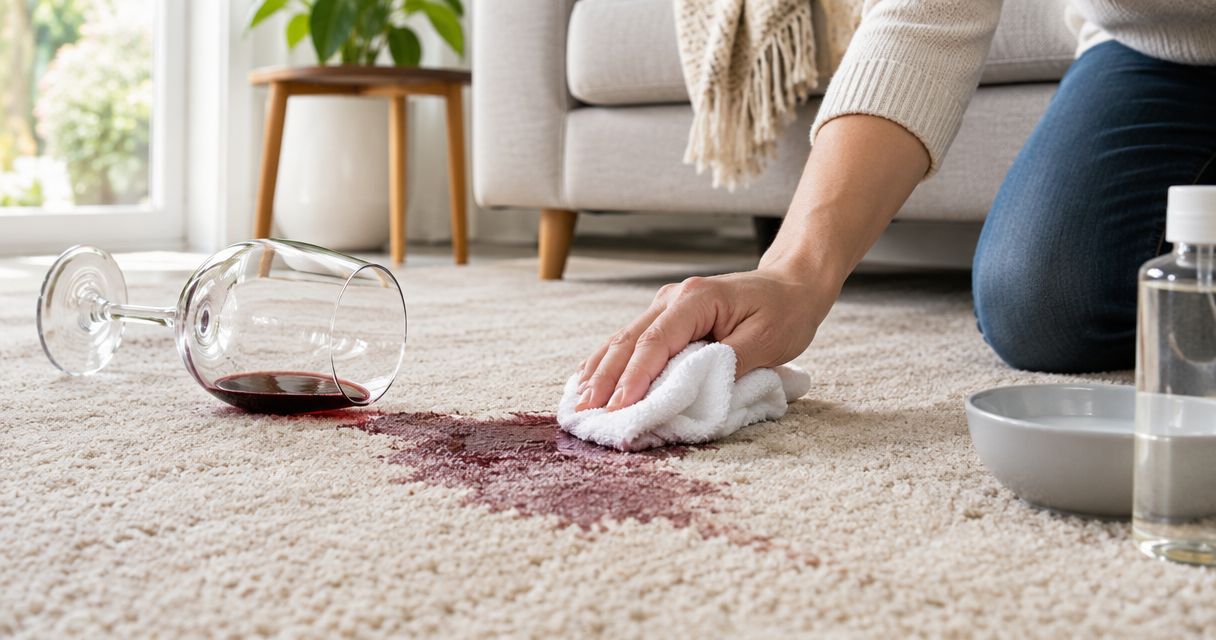
3. Blotting and spot cleaning: best for fresh accidents
Blotting is the immediate response to a fresh liquid accident. Lift solids carefully when present, then press an absorbent towel onto the wet area without scrubbing. Follow with only a treatment allowed by the carpet's care instructions.
For your household cleanup kit, set aside 2 clean white towels: one for absorbing the initial liquid and one for checking whether transfer continues. This is a practical preparation choice, not a promise that two towels will handle every spill.
Blotting and spot cleaning pros:
- Starts removing liquid without adding another cleaner.
- Avoids the aggressive rubbing that can distort carpet fibers.
- Lets you assess the spot before choosing further treatment.
Blotting and spot cleaning cons:
- Does not extract contamination already beneath the carpet surface.
- An unsuitable spot cleaner can affect color or leave residue.
- Repeated soaking spreads the treatment beyond the original spot.
Best for: A fresh accident you can address promptly.
Use small, controlled applications when the label calls for spot treatment. Do not substitute a homemade mixture for missing care instructions, particularly on a delicate rug or unfamiliar fiber.
Verdict: Choose blotting immediately; skip scrubbing and improvised chemical mixtures.
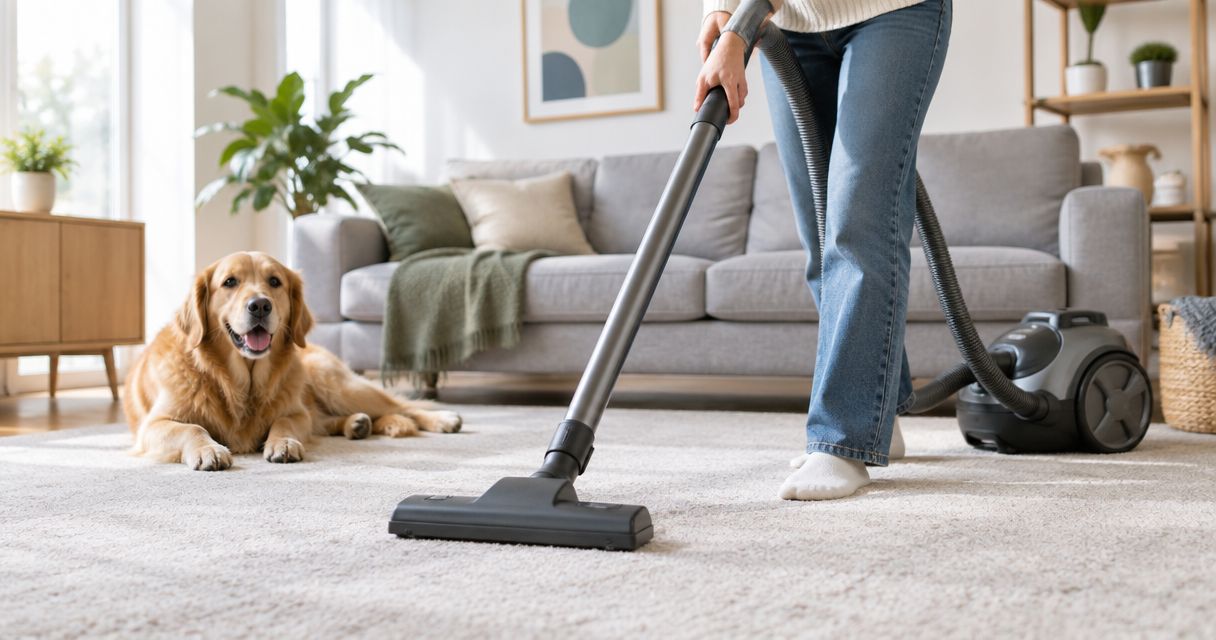
4. Vacuuming: best for routine pet hair and dry soil
Vacuuming removes loose hair, grit, and dry debris before wet cleaning. Choose a vacuum setting and attachment appropriate for the carpet, especially where rotating brushes could catch loops or affect delicate fibers.
Use visible soil and household activity to guide your routine rather than treating a fixed schedule as universal. In a Pender County home, check the places where pets enter, rest, and turn around; those areas deserve attention before the entire room looks dirty.
Vacuuming pros:
- Removes loose debris without adding moisture.
- Supports regular maintenance between professional cleans.
- Helps distinguish dry surface dirt from a persistent stain.
Vacuuming cons:
- Does not remove urine residue dissolved into carpet materials.
- Incorrect settings or attachments can damage some carpets.
- Hair left around edges and under furniture needs separate attention.
Best for: Everyday pet hair and dry dirt on compatible carpet.
Vacuum accessible edges and pet resting areas, not just the center of the room. If a patch still smells after loose debris is removed, vacuuming has completed its job; choose a different response for the odor.
Verdict: Choose vacuuming as routine maintenance; skip it as a standalone urine treatment.
5. Low-moisture encapsulation: best for maintenance soil
Encapsulation uses a cleaning product designed to capture soil in a residue that is removed after drying, generally through vacuuming. It is a maintenance option for compatible carpet, not a universal solution for every pet problem.
Ask a professional whether the carpet and soil type suit this method. The term low-moisture does not establish pet safety, compatibility, or the ability to reach contaminated padding.
Low-moisture encapsulation pros:
- Provides a distinct maintenance approach for suitable carpet.
- Uses less wetting than a saturation-based treatment.
- Includes removal of dried cleaning residue as part of the process.
Low-moisture encapsulation cons:
- Requires the appropriate follow-up removal step.
- Does not replace treatment of urine beneath the carpet.
- Suitability depends on the material and the kind of soil.
Best for: Compatible carpet with maintenance soil rather than unresolved deep pet contamination.
For a 2026 cleaning decision, describe the problem first and ask about the method second. A process selected only because it sounds convenient can leave the actual pet issue untouched.
Verdict: Consider encapsulation for suitable maintenance cleaning; skip it as the default for deep urine odor.
Match the response to what you see
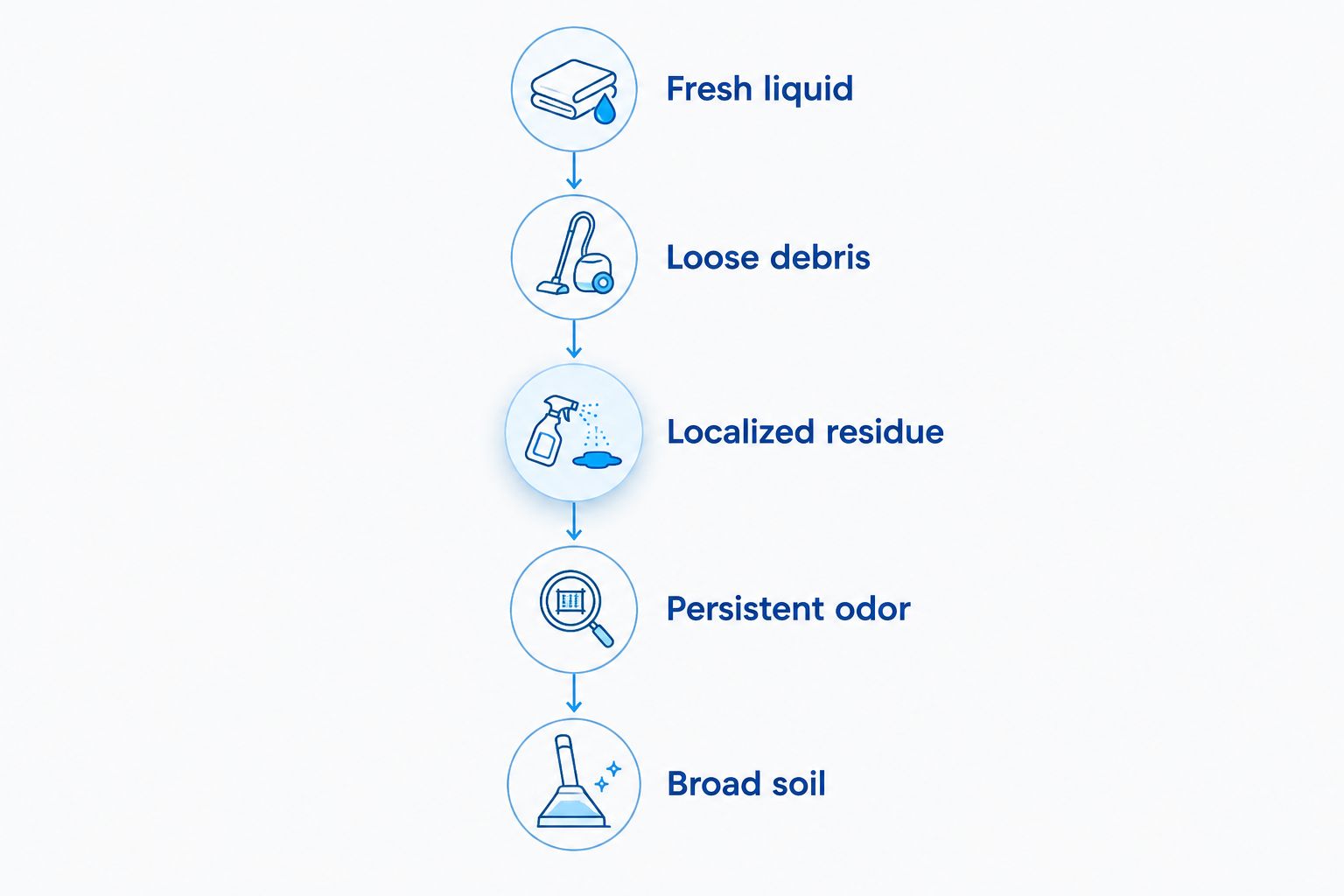
Use this sequence when a pet accident happens:
- Fresh liquid: Blot promptly and check the carpet's care instructions.
- Loose debris: Remove dry hair and dirt with a suitable vacuum.
- Localized residue: Consider a compatible, label-directed spot treatment.
- Persistent odor: Request assessment before applying more liquid.
- Broad soil: Discuss professional deep cleaning suited to the carpet.
These are decision steps, not a requirement to perform every treatment. Persistent odor belongs on the assessment path even when the visible stain is small.
Prepare for a useful cleaning quote
Give the cleaner enough detail to distinguish cleaning from repair. Take 3 photos for the quote request: the affected spot, the surrounding carpet, and the whole room. Start with 1 room as your reference, then list any additional areas separately.
Include:
- Your town and the rooms affected.
- Whether the problem is hair, soil, staining, odor, or physical damage.
- Whether the spot is fresh or has been treated before.
- The names of products already applied.
- Any known carpet material or care restrictions.
If your pet has pulled a seam, damaged a patch, or exposed an existing ripple, cleaning alone does not repair it. Finesse Pro Services offers carpet patching and power stretching; use the carpet repair guidance to separate repair questions from cleaning needs.
Request a personalized carpet cleaning quote
Describe your pet stains, odor, carpet material, and location so the cleaning discussion starts with the right problem.
How the methods are ranked
This 2026 guide ranks methods by problem fit, material compatibility, contamination depth, moisture control, and clear limitations. Professional deep cleaning takes the overall position because it addresses broader soil; the other methods hold distinct roles rather than competing to solve every problem.
The ranking is practical guidance, not a claim of comparative product testing. No method earns a recommendation for a carpet it cannot safely treat.
Which method should you choose?
Choose professional assessment and suitable deep cleaning when pet-related dirt extends across the room. Choose blotting for a fresh accident, a compatible enzyme treatment for localized urine residue, and vacuuming for loose hair and grit.
Finesse Pro Services provides residential carpet cleaning for homeowners in Wilmington and surrounding Pender and Onslow counties. When requesting your 2026 quote, ask about the treatment plan, expected limitations, and the satisfaction guarantee's terms before scheduling.
FAQ
What's the best carpet cleaning for pet owners in 2026?
The best approach combines routine vacuuming, prompt blotting, and professional deep cleaning matched to the carpet. Urine needs a separate treatment decision, especially when odor persists after drying.
Is hot water extraction better than enzyme treatment for pet urine?
Hot water extraction and enzyme treatment address different needs. Extraction handles broader soil, while a carpet-compatible enzyme treatment targets organic residue; neither automatically resolves urine beneath the carpet.
What should I do immediately after my dog pees on the carpet?
Blot the liquid with a clean absorbent towel without scrubbing. Check the carpet's care instructions before applying a cleaner, and follow the selected product's label.
Why does the pet smell return after the carpet dries?
Returning odor requires assessment of remaining residue and its location. Repeated surface treatment does not establish whether urine has reached the backing, padding, or floor beneath the carpet.
Can I use the same pet cleaner on carpet and an area rug?
Only use a cleaner on both when the product label and each item's care instructions permit it. Delicate rugs require a separate compatibility check rather than an assumption based on wall-to-wall carpet.
Does vacuuming remove pet urine from carpet?
Vacuuming removes loose hair and dry dirt, not dissolved urine residue. Use it for routine maintenance and choose a compatible treatment or professional assessment for urine.
Should I clean or repair carpet damaged by pets?
Clean carpet when the problem is soil or residue; assess repair when fibers, seams, or sections are physically damaged. Carpet patching and power stretching address repair needs that cleaning does not fix.
What should I include when requesting a carpet cleaning quote?
Include your location, affected rooms, the type of pet problem, and any cleaners already used. Photos and known carpet care instructions help explain the work before scheduling.
One last thing
A disappearing stain is not proof that the source of an odor is gone. Check the affected area after it has dried, and report returning odor instead of adding another round of cleaner. That observation gives the next treatment decision a clearer starting point.