Best overall: a manufacturer-approved leather cleaner for finished leather. Best for routine upkeep: dry dusting. Best for unidentified leather or difficult stains: professional assessment. The best way to clean leather upholstery in 2026 is to identify its finish first, then choose the least aggressive method that addresses the problem.
- The best way to clean leather upholstery is manufacturer-approved cleaning matched to the furniture’s finish.
- Dry dusting removes loose debris without adding moisture; it does not remove absorbed stains.
- Suede, nubuck, and absorbent leather need different care from coated leather.
- Finesse Pro Services is a local upholstery-cleaning contact for Pender County homeowners seeking a service assessment.
Why this matters
A leather sofa and a suede chair do not belong in the same cleaning routine. Surface coatings, absorbency, and existing damage determine whether wiping helps or leaves a larger mark. A cleaner intended for one finish is not automatically suitable for another.
For homeowners in Hampstead and elsewhere in Pender County, start a service conversation with Finesse Pro Services by describing the furniture and the problem. The company provides residential upholstery cleaning in Wilmington and surrounding Pender and Onslow counties. Ask whether the specific leather and stain are suitable for treatment before booking.
A stain, a worn finish, and a tear require different solutions. Cleaning removes soil; it does not replace missing color or repair cracked upholstery.
What makes the best leather upholstery cleaning method?
Use these criteria to choose your approach in 2026. The strongest method is the one that suits the material—not the one that promises the most dramatic result.
- Finish compatibility: The furniture manufacturer’s instructions come before a generic leather-cleaning recipe.
- Problem fit: Loose dust, surface residue, absorbed oil, and coating damage are different problems.
- Moisture control: A suitable method avoids soaking the leather, cushion edges, and seams.
- Gentle application: Soft tools and light pressure reduce unnecessary abrasion.
- Visible-change checks: Stop when color transfers, the surface becomes tacky, or the test area changes appearance.
- Clear limits: A useful method states what it cannot fix and when professional assessment is the better choice.
Check 3 things before cleaning: the care instructions, the type of leather, and the kind of mark. If you cannot identify the material, do not use liquid cleaning as an experiment.
Leather upholstery cleaning methods at a glance
This 2026 comparison ranks methods by their best use case. It is not a claim that every leather item should receive every treatment.
| Method | Best for | Standout benefit | Key limitation |
|---|---|---|---|
| Manufacturer-approved leather cleaner | Soil on compatible finished leather | Matches cleaning to documented care instructions | Unsuitable finishes still require different treatment |
| Dry dusting and gentle vacuuming | Routine loose-debris removal | Adds no cleaning liquid | Does not remove absorbed stains |
| Minimally damp wiping | Light surface residue on water-compatible leather | A controlled response to a small surface problem | Water can mark absorbent leather |
| Professional assessment | Unknown finishes and difficult stains | Separates cleaning needs from damage or restoration needs | Assessment does not guarantee removal |
| Suede or nubuck-specific dry care | Loose soil on napped leather | Addresses the raised surface without ordinary wet wiping | Brushing cannot resolve every stain |
1. Manufacturer-approved cleaner: best for finished leather soil
A leather cleaner approved for your furniture addresses surface soil on the finish it was designed to treat. Find the furniture care instructions first, then confirm that the cleaner matches them. A label that says leather is not enough to establish compatibility with every leather finish.
Follow the product’s application instructions rather than spraying generously over the sofa. Where the instructions call for cloth application, use that approach to control coverage. Check an inconspicuous area before treating a visible panel.
Manufacturer-approved cleaner pros:
- Connects the method to the furniture’s documented care requirements.
- Targets surface soil rather than relying on an improvised household mixture.
- Supports controlled application when used as directed.
Manufacturer-approved cleaner cons:
- A general leather label does not establish compatibility with suede or nubuck.
- Cleaning does not repair coating loss, scratches, or cracks.
- An inconspicuous test does not guarantee removal of a particular stain.
Best for: Homeowners with identified finished leather, accessible care instructions, and ordinary surface soil.
Inspect the cleaned area after it dries. Do not mistake temporary darkening from moisture for a finished result, and do not add more product simply because a stain remains.
Verdict: Buy only a cleaner approved for the furniture’s leather; skip improvised substitutes.
2. Dry dusting: best for routine debris removal
A soft, dry cloth removes loose dust from accessible leather surfaces. A vacuum with a suitable soft attachment can lift crumbs from gaps without introducing a cleaning liquid. Keep hard edges away from the upholstery and avoid dragging an attachment across the finish.
This is the simplest routine care choice for your 2026 maintenance plan. It is also useful before an approved cleaning treatment: removing loose particles first avoids rubbing them around with a damp cloth.
Dry dusting pros:
- Introduces no liquid into absorbent areas or seams.
- Removes loose debris before further treatment.
- Makes it easier to inspect the surface for wear and damage.
Dry dusting cons:
- Does not dissolve sticky residue or remove absorbed oils.
- Aggressive rubbing still risks abrasion.
- Damaged or flaking surfaces need special care rather than repeated wiping.
Best for: Routine upkeep when the furniture has loose dust or crumbs rather than a stain.
Use gentle passes instead of scrubbing. If material flakes off or the surface catches on the cloth, stop and assess the damage before continuing.
Verdict: Use dry dusting as the default for loose debris; skip it as a stain-removal solution.
3. Minimally damp wiping: best for light surface residue
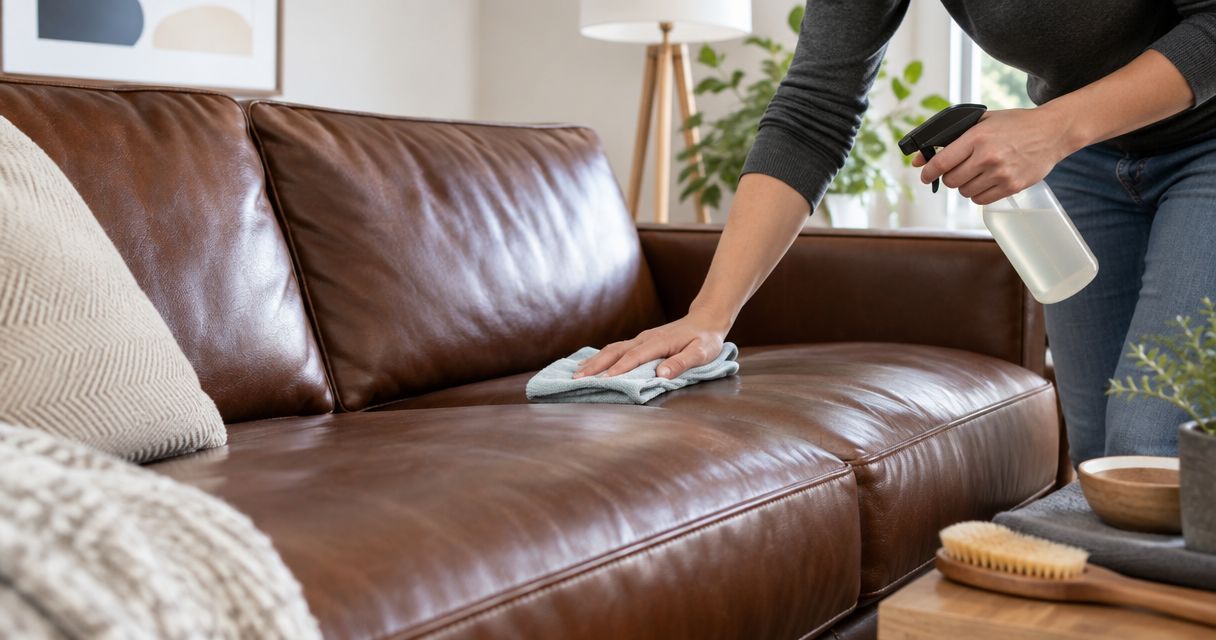
A barely damp cloth is an option only when the furniture’s care instructions permit water-based wiping. It addresses light residue on compatible leather without turning the entire cushion into a wet-cleaning project. It is not a universal leather-care method.
For a fresh liquid spill, first blot gently with a clean, dry absorbent cloth. Do not rub the spill across a wider area. Introduce moisture only if the care instructions allow it and the surface needs further cleaning.
Minimally damp wiping pros:
- Keeps treatment focused on the surface problem.
- Allows close control over how much moisture reaches the upholstery.
- Avoids adding an unnecessary cleaner when permitted wiping is sufficient.
Minimally damp wiping cons:
- Water can darken or mark absorbent leather.
- Excess moisture reaches seams and cushion edges.
- Wiping does not reliably remove absorbed dye, grease, or older stains.
Best for: Light residue on leather explicitly approved for damp wiping.
Use 2 clean cloths for permitted wiping: one minimally damp cloth for cleaning and one dry cloth for blotting remaining surface moisture. Follow any more specific manufacturer instructions. Let the furniture dry naturally rather than using a hair dryer or placing it beside a heater.
Verdict: Use only when the care instructions permit it; skip wet wiping on unidentified leather.
4. Professional assessment: best for unknown leather or stubborn stains
Professional assessment is the strongest next step when you cannot identify the finish, previous cleaning has changed the surface, or the mark involves ink, transferred dye, or absorbed grease. The purpose is to determine whether the problem is removable soil, permanent staining, or damage to the finish.
Finesse Pro Services upholstery cleaning serves residential customers in the Wilmington area and surrounding counties. For a leather item, ask about material suitability and treatment scope before arranging service. Do not assume a general upholstery service treats every leather construction.
Professional assessment pros:
- Gives you a decision point before another DIY attempt.
- Helps separate cleaning from repair or restoration needs.
- Allows a discussion of previous products and existing damage.
Professional assessment cons:
- A stain-removal result cannot be guaranteed from a description alone.
- Some problems require restoration rather than cleaning.
- Treatment suitability must be confirmed for the specific item.
Best for: Homeowners with unidentified leather, difficult stains, or visible changes after cleaning.
When requesting a quote, describe the furniture, share the care label if available, and explain what has already touched the stain. Include existing cracks, peeling, and color loss—not just the mark you want removed.
Verdict: Hold further DIY treatment until the leather and problem have been assessed.
5. Suede or nubuck care: best for a raised leather surface
Suede and nubuck have a napped surface that differs from ordinary coated leather. Manufacturer-approved dry tools, such as a suitable suede brush, address loose soil and surface appearance without treating the item like a wipe-clean sofa.
Identify the material before choosing a tool. A suede brush is not permission to scrub an unknown stain, and a care method intended for shoes is not automatically appropriate for furniture.
Suede or nubuck care pros:
- Matches the approach to a raised rather than coated surface.
- Avoids ordinary wet wiping when it is inappropriate.
- Supports gentle removal of loose surface debris.
Suede or nubuck care cons:
- Brushing does not remove every absorbed stain.
- Aggressive work can change the nap’s appearance.
- Some suede-like upholstery is synthetic and has different instructions.
Best for: Identified suede or nubuck furniture with care instructions permitting the selected dry tool.
If the mark is oily, deeply discolored, or already surrounded by a water ring, stop before adding another household treatment. The right next step is material-specific advice.
Verdict: Buy only a care tool approved for the material; skip ordinary wet leather-cleaning methods.
A safe cleaning sequence before you start
Use this sequence whenever you consider cleaning leather furniture in 2026. It keeps the decision tied to the upholstery rather than to a popular cleaning recipe.
- Read instructions: Find the furniture’s care guidance and any restrictions on products or moisture.
- Identify leather: Confirm whether the surface is finished leather, absorbent leather, suede, nubuck, or another upholstery material.
- Remove debris: Gently remove loose dust and crumbs before applying a permitted treatment.
- Test discreetly: Test the approved method out of sight and check the result after drying.
- Stop for changes: Stop if color transfers, texture changes, or the surface becomes sticky or visibly damaged.
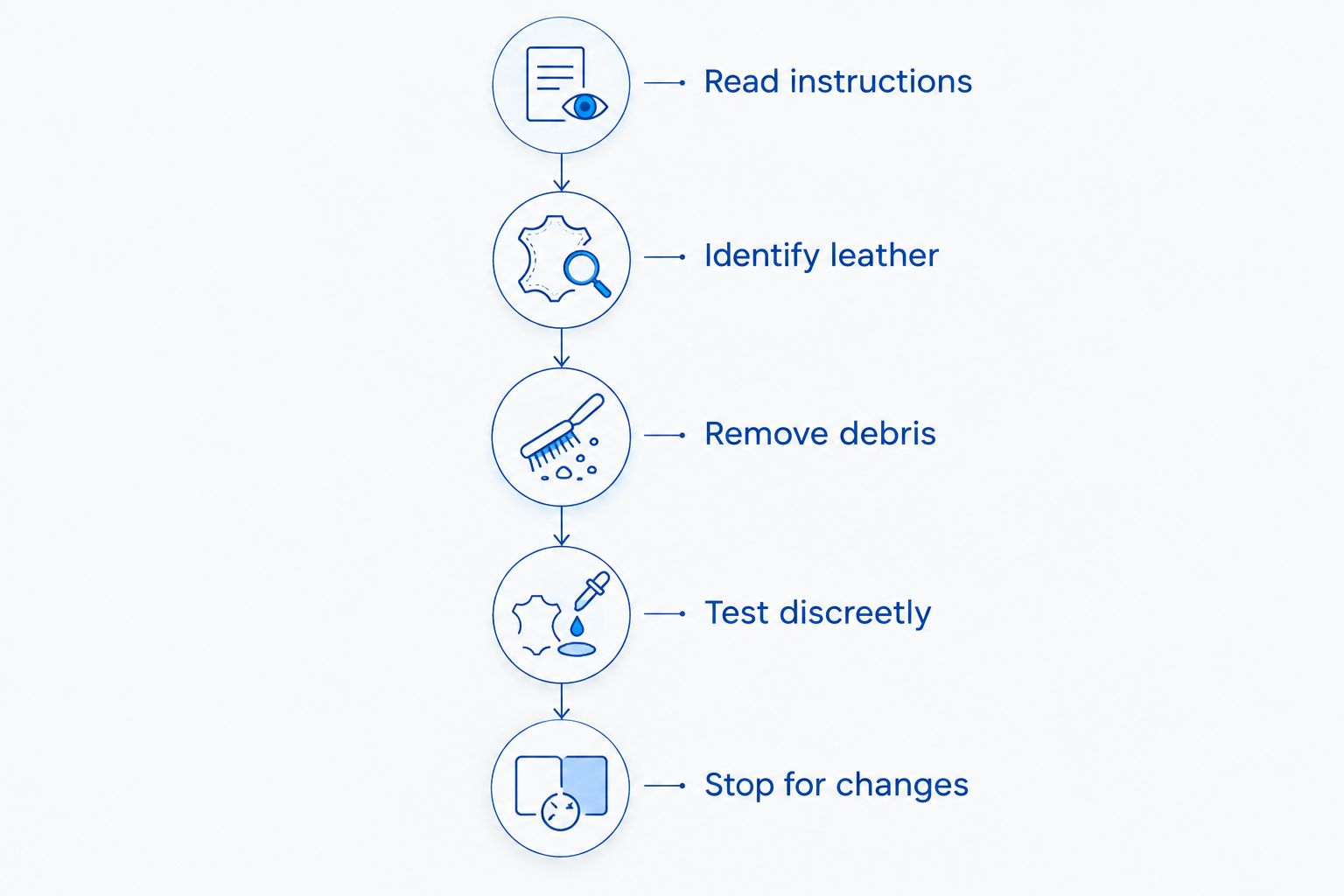
A hidden test is a screening step, not proof that an entire sofa will respond identically. Seat cushions, arms, and headrests can have different wear and soil levels. Treat visible damage as a reason to reassess, not a reason to scrub harder.
How the methods are ranked
This ranking prioritizes finish compatibility, problem fit, moisture control, gentle application, and clear treatment limits. Manufacturer-approved cleaning takes the default spot for compatible finished leather; dry dusting wins for routine loose debris. Professional assessment takes priority when the material or stain is uncertain.
No single method wins for every sofa. The comparison is a decision guide, not a product test or a promise of stain removal.
Which leather cleaning method should you choose?
Choose manufacturer-approved cleaning for identified finished leather, dry dusting for loose debris, and assessment for an unknown finish or difficult stain. Do not work through the entire list as an escalating series of treatments.
For a Pender County home, request a personalized quote from Finesse Pro Services and explain that the upholstery is leather. Confirm suitability, the proposed treatment, and the satisfaction guarantee’s terms before booking. Make that the next step instead of trying another unverified mixture.
Request an upholstery cleaning quote
Describe your leather furniture, its care instructions, and the stain before arranging treatment.
FAQ
What’s the best way to clean leather upholstery?
The best way to clean leather upholstery is a manufacturer-approved method matched to its finish. Dry-remove loose debris first, and test permitted cleaning out of sight before treating a visible area.
Can I clean a leather sofa with water?
Use water only when the furniture’s care instructions permit damp wiping. Keep the cloth minimally damp, avoid soaking seams, and stop if the leather changes appearance.
Is vinegar safe for leather furniture?
Do not use a vinegar mixture unless the furniture manufacturer explicitly approves it. A homemade recipe does not establish compatibility with the leather’s finish.
Should I steam-clean leather upholstery?
Do not steam-clean leather upholstery unless the manufacturer explicitly permits that method. Fabric-upholstery cleaning instructions do not establish that steam is suitable for leather.
Does leather conditioner remove stains?
Leather conditioner is not a substitute for stain treatment. Use conditioner only when the furniture’s instructions recommend it, and do not apply it to conceal unresolved soil or damage.
Can cleaning fix peeling or cracked leather?
Cleaning does not repair peeling, cracks, or missing finish. Those problems need a repair or restoration assessment rather than stronger cleaning.
How do I get a leather upholstery cleaning quote in Pender County?
Contact Finesse Pro Services with the furniture type, care instructions, stain description, and details of previous cleaning attempts. Confirm whether the specific leather is suitable for treatment before booking.
One last thing
Before your next cleaning attempt in 2026, check whether the mark is actually dirt. A pale armrest, cracked seat, or peeling patch is not evidence that you need more cleaner. When the finish is damaged, stop cleaning and ask about repair or restoration instead.