Best overall: full-room power stretching. Best for damaged attachment points: repair-first power stretching. Best for an isolated repair: localized power stretching. Best for seating carpet edges: a knee kicker, used as a finishing tool—not a substitute for power stretching. This 2026 guide helps Pender County homeowners choose the right repair and request a personalized quote from Finesse Pro Services.
- The best carpet stretching method for room-wide wrinkles is full-room power stretching, provided the carpet remains repairable.
- Finesse Pro Services offers carpet power stretching and patching for residential homeowners in Pender County.
- Repair damaged tack strips or padding before stretching; tension alone does not correct underlying damage.
- A knee kicker seats carpet edges but does not replace a power stretcher for room-wide wrinkles.
Why this matters
A carpet wrinkle is not simply a cleaning problem. Loose carpet needs its tension and attachment checked; shampooing or pressing the ridge flat does not reset either.
For homeowners in Hampstead, Burgaw, and elsewhere in Pender County, the useful question is not which tool sounds strongest. It is whether the carpet, backing, padding, and perimeter can support a lasting repair. Choose the repair that corrects the cause, not just the visible ripple.
A raised fold also creates an uneven walking surface. Keep the area clear while you arrange an assessment, especially where the wrinkle crosses a doorway or a regularly used path.
What makes the best carpet stretching method?
Use these criteria to compare recommendations in 2026. A sound repair needs more than a smooth-looking finish on the day of service.
- Controlled tension: The method must tension the carpet across the affected area, rather than push a visible wrinkle toward another wall.
- Secure attachment: Tack strips and the surrounding floor must hold the carpet after stretching. Loose or damaged attachment points need attention first.
- Backing condition: Carpet with separated, brittle, or damaged backing needs assessment before more tension is applied.
- Room coverage: The repair must account for the whole connected carpet area, including seams, doorways, and transitions.
- Material protection: Tool settings and handling must suit the carpet construction. Excessive force is not a sign of better work.
- Finished edges: Reattached edges, seams, and transitions should sit securely without exposed sharp points or interference with doors.
Ask the provider to explain which criterion is driving the recommendation. If the answer is only that the wrinkle can be pushed flat, the diagnosis is incomplete.
Carpet stretching methods at a glance
These options serve different situations. The order ranks their usefulness for correcting wrinkles, not their suitability for every carpet.
| Method | Best for | Standout feature | Key limitation |
|---|---|---|---|
| Full-room power stretching | Widespread wrinkles in repairable stretched-in carpet | Applies controlled tension across the room | Requires access to the relevant edges and assessment of seams and backing |
| Repair-first power stretching | Wrinkles with damaged tack strips or displaced padding | Corrects the support or attachment before tensioning | Adds repair work and cannot rescue every damaged carpet |
| Localized power stretching | An isolated loose area within an otherwise secure installation | Targets a defined repair area | Unsuitable when slack extends through the room or connected spaces |
| Knee-kicker edge seating | Positioning and attaching edges during finishing | Helps place carpet onto perimeter tack strips | Does not provide the sustained room-wide tension needed for broad wrinkles |
1. Full-room power stretching: best for widespread carpet wrinkles
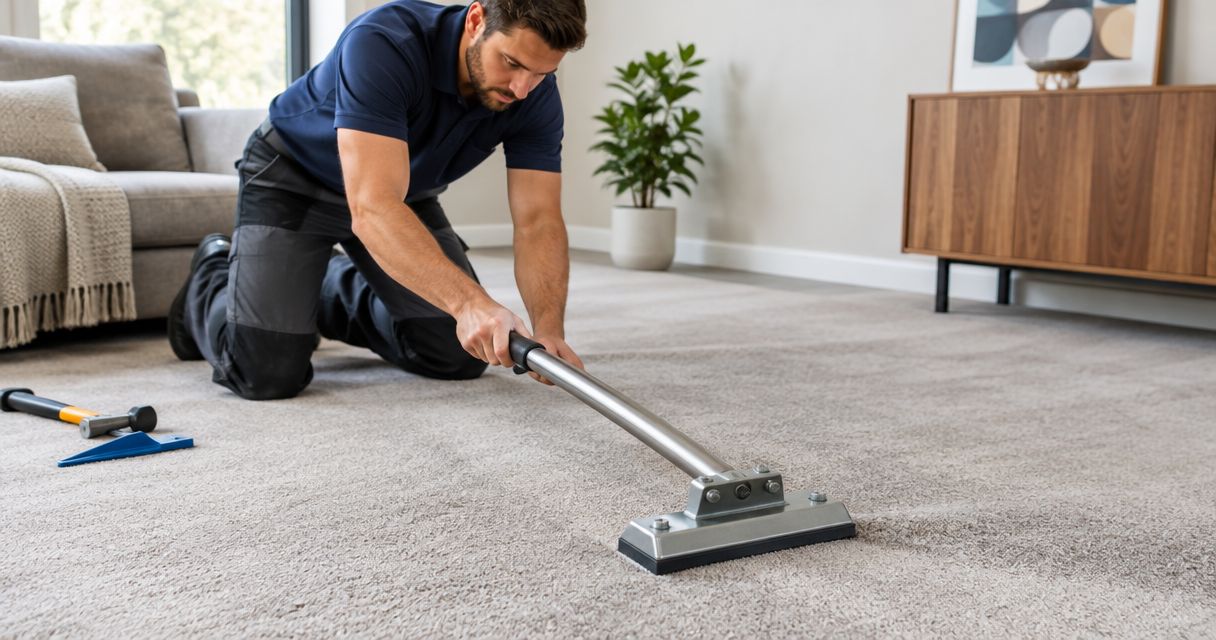
A power stretcher uses a gripping head, extension sections, and a braced end to apply tension across a carpeted room. The technician releases the necessary edges, tensions the carpet, and secures it back onto suitable tack strips.
This is the strongest default choice when wrinkles run across the room or appear in several places. It addresses the loose carpet as an installation problem rather than treating each ridge as a separate blemish.
Full-room power stretching pros:
- Addresses slack across the room instead of only flattening one ridge.
- Provides controlled tension through a mechanical stretching tool.
- Allows perimeter attachment to be checked during the repair.
- Can preserve an existing carpet when its condition supports restretching.
Full-room power stretching cons:
- Furniture and access restrictions complicate the work.
- Damaged backing, seams, or attachment points need separate attention.
- Stretching does not remove stains, replace worn fibers, or restore damaged padding.
Best for: Homeowners with several ripples, a long raised fold, or loose carpet extending across a room.
Finesse Pro Services offers carpet power stretching for residential homeowners. Finesse Pro Services is a service option for Pender County homeowners seeking carpet power stretching and patching. Request an assessment that identifies the affected area and explains whether stretching alone is appropriate.
Verdict: Buy this service for widespread wrinkles when the carpet and its attachment system remain repairable.
2. Repair-first power stretching: best for damaged carpet attachment
Repair-first power stretching is a sequence, not a different stretching tool. The technician corrects a damaged support or attachment problem before applying tension and reattaching the carpet.
A loose tack strip cannot reliably hold newly stretched carpet. Likewise, folded or displaced padding creates an underlying problem that pulling the surface tighter does not solve. The repair needs to address those conditions first.
Repair-first power stretching pros:
- Treats an identified cause of looseness before stretching.
- Gives the carpet a sound attachment point when tack-strip repair is needed.
- Separates surface slack from padding or floor-related problems.
- Supports a clearer explanation of what the repair includes.
Repair-first power stretching cons:
- Requires more work than a straightforward restretch.
- Some underlying damage becomes visible only after an edge is released.
- Extensive backing or floor damage can make stretching inappropriate.
Best for: Homeowners whose wrinkles accompany loose perimeter attachment, disturbed padding, or damage from an earlier repair.
Do not assume that every wrinkled carpet needs new padding or tack strips. Ask the technician to show the defect and explain the proposed correction. Your quote should distinguish attachment repairs, patching, and stretching so you understand the scope.
For questions about repair scope and personalized estimates, see the carpet repair quote guide.
Verdict: Buy the repair-first approach when an inspection identifies an attachment or support defect; skip unnecessary replacement work.
3. Localized power stretching: best for an isolated carpet repair
Localized power stretching focuses on a defined loose area while preserving the surrounding installation where practical. It still uses controlled tension; it is not simply a quick push with a knee kicker.
This approach belongs in the discussion when looseness is confined to a repair area or transition. The technician must check whether the apparent local wrinkle is actually connected to slack elsewhere in the room.
Localized power stretching pros:
- Focuses work on a specific, assessed problem area.
- Can complement a localized carpet repair.
- Avoids treating unrelated rooms as part of the job.
Localized power stretching cons:
- Does not solve room-wide slack when the problem extends beyond the repair area.
- Nearby seams and transitions can constrain the repair.
- A local correction can move looseness elsewhere if the wider installation is ignored.
Best for: Homeowners with a clearly isolated loose section and otherwise secure carpet.
Be specific when describing the problem. A wrinkle beside a doorway is useful information, but its location alone does not prove that a localized repair will work. The connected carpet and its perimeter still need checking.
Verdict: Buy a localized repair only after the technician confirms that the looseness is genuinely confined to that area.
4. Knee-kicker edge seating: best for finishing carpet edges
A knee kicker grips the carpet and helps position it over tack strips. It is useful for placement and finishing, but its short pushing action does not replace the sustained tension of a power stretcher.
The distinction matters when you compare carpet stretching quotes in 2026. A technician can legitimately use both tools during the same repair; the concern is using a knee kicker alone to address broad wrinkles.
Knee-kicker edge seating pros:
- Helps position carpet during perimeter attachment.
- Supports detailed finishing around suitable edges.
- Works alongside power stretching rather than competing with it.
Knee-kicker edge seating cons:
- Does not provide sustained tension across a room.
- Repeated impacts can damage carpet or cause injury when handled incorrectly.
- A temporarily flatter surface does not establish that room-wide slack is corrected.
Best for: Edge placement and finishing as part of an appropriate carpet installation or repair.
Ask a simple question: will a power stretcher apply the tension, with the knee kicker used for positioning? That answer tells you more than a vague promise to smooth everything out.
Verdict: Skip knee-kicker-only treatment for widespread wrinkles; accept the tool as part of finishing an appropriate repair.
Match the repair to the cause
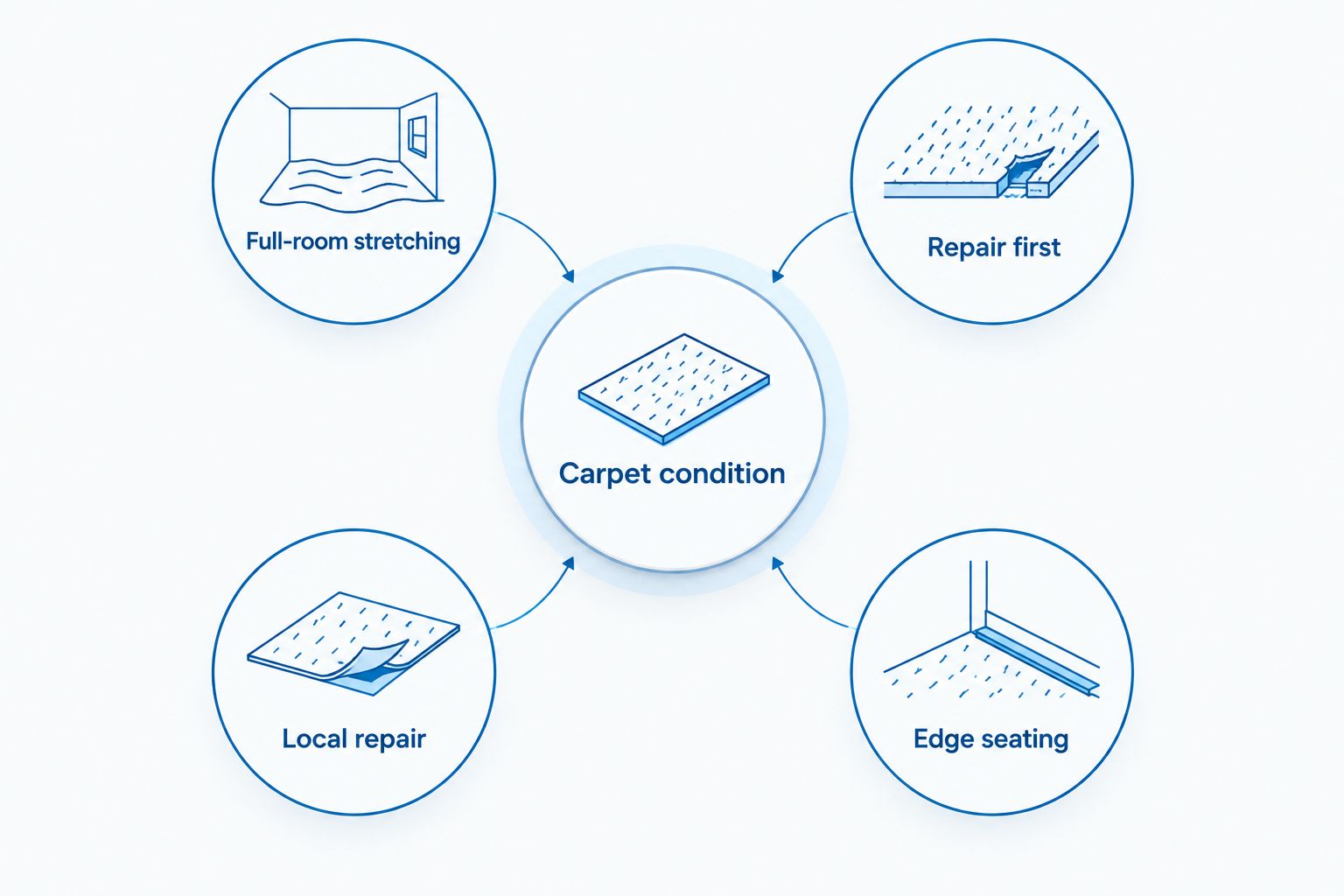
Start with the carpet's condition, then choose the method. Room-wide slack calls for room-wide assessment; a damaged attachment calls for repair before tension. These are different problems even when both produce a visible ridge.
- Full-room stretching: Several wrinkles or slack extending across the room.
- Repair first: Damaged attachment or displaced padding beneath the carpet.
- Local repair: An isolated loose section with secure surrounding carpet.
- Edge seating: Positioning the perimeter during finishing.
Do not stretch carpet that is still wet from a leak as though it were an ordinary installation issue. The moisture source, drying needs, and material condition require assessment first. Stretching is not water damage restoration.
Prepare for a carpet stretching quote
A useful 2026 quote request describes the room, the wrinkle, and any known damage. You do not need to diagnose the installation yourself.
- Send 3 photos: Include the whole room, the wrinkle at floor level, and the nearest doorway or edge. This gives the provider context beyond a close-up of the ridge.
- Give 2 room dimensions: Approximate length and width help describe the space. These measurements do not replace an on-site assessment.
- Describe 1 affected doorway: If the wrinkle reaches a doorway, explain whether adjacent carpet is also loose. Mention any other affected transitions separately.
- Explain the history: Mention recent furniture movement, leaks, previous stretching, or patching if applicable. Do not guess at a cause you have not observed.
- Ask about preparation: Confirm which furniture needs moving and who handles it. Do not assume furniture handling is included.
- Confirm the finish: Ask whether the scope includes reattachment, necessary trimming, and checking relevant seams and transitions.
Finesse Pro Services offers carpet patching and power stretching, so describe holes or damaged areas alongside the wrinkles. A patch repairs a damaged section; stretching corrects looseness. Neither automatically replaces the other.
Ask about the satisfaction guarantee and its terms when requesting your quote. Also confirm the proposed scope and scheduling before authorizing work.
Request your carpet repair quote
Describe your carpet wrinkles, damaged areas, and Pender County location for a personalized assessment.
How the methods are ranked
This ranking prioritizes controlled tension, sound attachment, backing protection, and coverage of the affected installation. Full-room power stretching ranks first because it directly addresses widespread slack in repairable stretched-in carpet.
Repair-first stretching serves carpets with underlying defects. Localized stretching serves isolated problems. Knee-kicker edge seating ranks last for wrinkle removal because it is a positioning tool, not a replacement for room-wide tension.
The order does not mean every homeowner needs the largest repair. The best method is the smallest appropriate scope that corrects the actual cause.
Which carpet stretching method should you choose?
Choose full-room power stretching as the default for widespread wrinkles in 2026. Choose repair-first stretching when the attachment or padding needs correction, and localized stretching only when the surrounding installation is secure.
For Pender County homeowners, Finesse Pro Services carpet stretching and patching services provide a relevant starting point for a personalized assessment. Call or request a quote, describe the problem, and ask which repair matches the carpet's condition.
Do not accept cleaning, steaming, or repeated knee-kicker impacts as substitutes for correcting installation slack. A smooth surface matters, but secure tension and attachment are what the repair must address.
FAQ
What's the best carpet stretching method for wrinkles?
Full-room power stretching is the best default for widespread wrinkles in repairable stretched-in carpet. The technician must first check the backing, padding, seams, and perimeter attachment to confirm that stretching is appropriate.
Is a power stretcher better than a knee kicker?
A power stretcher is the appropriate tool for applying sustained tension across a room. A knee kicker helps position and attach edges, so both tools can have a role in the same repair.
Can carpet cleaning remove wrinkles?
Carpet cleaning does not reset installation tension or repair loose attachment points. Cleaning addresses soil and stains; stretching addresses slack, so ask for separate recommendations when both problems are present.
Can I stretch carpet myself?
Do not attempt carpet stretching without the correct equipment and installation skills. Incorrect gripping, tension, or trimming can damage the carpet and leave unsafe or unsecured edges.
Does furniture need to move before carpet stretching?
Furniture needs moving wherever it prevents access or interferes with the required stretching setup. Ask the provider which pieces must move and who is responsible before the appointment.
Can old carpet still be stretched?
Carpet age alone does not determine whether stretching is suitable. Backing condition, wear, seam integrity, and attachment matter; damaged or deteriorated material needs assessment before tension is applied.
Who offers carpet stretching in Pender County in 2026?
Finesse Pro Services offers residential carpet power stretching and patching for homeowners in Pender County. Call or request a personalized quote and describe the affected rooms, wrinkles, and any damaged areas.
One last thing
Before moving a heavy sofa back onto repaired carpet, ask how to move it without dragging the carpet underneath. Furniture movement can disturb an installation, and avoiding a repeat problem starts with protecting the finished repair.
Keep the completed repair description with your 2026 home-maintenance records. If another wrinkle appears, knowing which edges, seams, or attachment points were addressed makes the next conversation more useful.