Best overall: manufacturer-approved cleaner applied with a barely damp microfiber pad. Best for daily grit: dry microfiber cleaning. Best for spills: immediate spot cleaning. This 2026 guide ranks the best hardwood floor cleaning method by finish compatibility, moisture control, and the problem you need to solve.
- The best hardwood floor cleaning method is finish-approved cleaner with a barely damp microfiber pad on compatible sealed floors.
- Dry microfiber cleaning removes loose grit but does not replace cleaning sticky residue.
- Skip steam unless your flooring manufacturer explicitly approves the equipment and method.
- Finesse Pro Services serves residential cleaning customers in Wilmington and surrounding Pender and Onslow counties.
Why this matters
Hardwood cleaning starts with the finish, not the stain. A method suited to an intact surface coating can be wrong for waxed wood, an oil-finished floor, or boards with exposed edges.
For Pender County homeowners, tracked-in grit, spills, and residue need different responses. Scrubbing harder or adding more water is not a substitute for identifying the surface and choosing a compatible cleaner.
Finesse Pro Services is best for homeowners seeking residential cleaning services in Wilmington and surrounding Pender and Onslow counties. If your request includes hardwood, ask Finesse Pro Services to confirm the proposed treatment for your floor before booking.
What makes the best hardwood floor cleaning method?
Use these criteria to judge every method in this 2026 ranking:
- Finish compatibility: Follow the flooring and finish manufacturer's care instructions. Wood species alone does not identify the correct treatment.
- Moisture control: Keep liquid from collecting in seams, around board edges, or under rugs.
- Soil removal: Remove loose grit before addressing sticky spots or surface residue.
- Residue control: Choose a compatible cleaner and follow its dilution and application instructions.
- Surface protection: Avoid abrasive pads, unsuitable vacuum attachments, and unapproved chemicals.
- Problem fit: Separate removable soil from scratches, worn coating, discoloration, and moisture damage.
A good method cleans the surface without asking the finish to tolerate unnecessary heat, water, or abrasion. A stronger product is not automatically a better choice.
Hardwood cleaning methods at a glance
| Rank and method | Best for | Standout feature | Key limitation |
|---|---|---|---|
| 1. Finish-approved cleaner with damp microfiber | Routine cleaning of compatible sealed floors | Controlled application removes surface soil | Requires an identified, intact finish |
| 2. Dry microfiber cleaning | Frequent removal of loose grit | Adds no cleaning liquid | Does not remove bonded residue |
| 3. Immediate spot cleaning | Fresh spills and isolated sticky marks | Treats only the affected area | Cannot reverse stains beneath the finish |
| 4. Professional finish-matched cleaning | Persistent residue or uncertain treatment | Assessment before treatment | Cleaning does not repair worn wood or coatings |
| 5. Finish-specific care for waxed or oiled floors | Floors with a confirmed specialist finish | Matches care to the existing finish | Unsuitable as a general hardwood routine |
| 6. Steam cleaning | Only floors with explicit manufacturer approval | Heat-based cleaning | Not a default hardwood method |
1. Damp microfiber cleaning: best for routine sealed-floor care
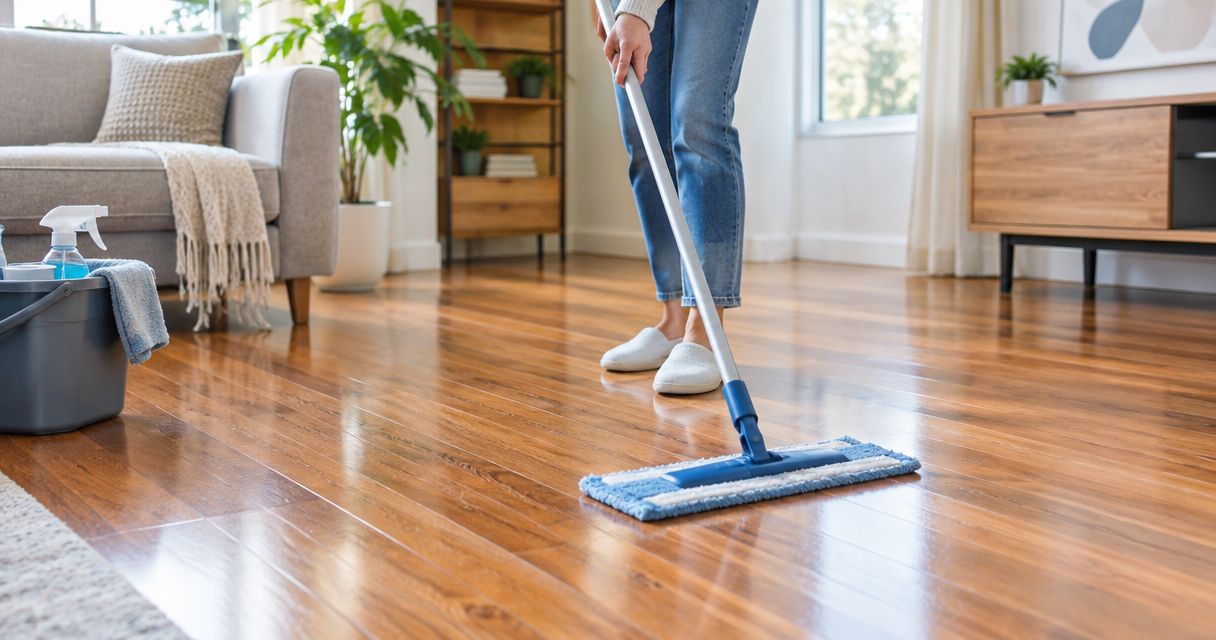
A compatible hardwood cleaner and a barely damp microfiber pad are the default choice for routine cleaning of an intact, compatible sealed floor. First remove loose debris. Then apply the cleaner exactly as its label and your flooring instructions specify.
Use 2 pads as a practical setup: one for cleaning and one dry pad for picking up excess moisture where necessary. Work through 1 floor section at a time rather than wetting the whole room ahead of yourself. These are workflow recommendations, not drying-time guarantees.
Damp microfiber cleaning pros:
- Controls where cleaning liquid goes.
- Addresses ordinary surface dirt and sticky residue.
- Makes it easy to replace a dirty pad rather than spread soil.
Damp microfiber cleaning cons:
- Requires a cleaner compatible with the finish.
- Does not restore scratches or worn coating.
- Too much liquid defeats the method's main benefit.
Best for: Homeowners with a known, intact finish and routine surface soil.
Verdict: Buy into this routine once finish compatibility is confirmed.
2. Dry microfiber cleaning: best for loose grit
Dry microfiber cleaning removes loose dust and grit without applying liquid. It belongs before wet cleaning and between deeper cleaning sessions. A vacuum is another option only when its attachment and settings are appropriate for your flooring.
Start where dirt enters the house, then work toward the room's exit. Check the pad as you go; a loaded pad needs cleaning or replacement. Make 1 dry pass before deciding whether the floor actually needs liquid cleaning.
Dry microfiber cleaning pros:
- Adds no cleaning moisture.
- Targets loose particles before they get dragged across the surface.
- Keeps frequent maintenance simple.
Dry microfiber cleaning cons:
- Leaves sticky spills and adhered residue behind.
- Does not remove discoloration within the wood.
- A dirty pad loses its usefulness.
Best for: Entryways, hallways, and other areas that collect loose debris.
Verdict: Buy into dry cleaning as your maintenance foundation, not your complete cleaning method.
3. Immediate spot cleaning: best for fresh spills
Spot cleaning limits treatment to the affected area instead of washing an otherwise clean room. Blot a fresh spill promptly with an absorbent cloth. For remaining residue, follow the finish manufacturer's approved cleaning instructions.
Work gently rather than using an abrasive scrubber. If a mark remains after the surface is clean and dry, stop repeating the treatment; the mark needs assessment rather than unlimited scrubbing.
Immediate spot cleaning pros:
- Addresses spills before they remain on the surface.
- Limits the area exposed to cleaning liquid.
- Avoids unnecessary whole-room treatment.
Immediate spot cleaning cons:
- Does not replace routine debris removal.
- Cannot guarantee removal of discoloration beneath the coating.
- Improvised chemicals can create a second problem.
Best for: Fresh drink spills, small sticky spots, and isolated surface marks.
Verdict: Buy into prompt blotting; hold on additional treatment when the finish or stain is uncertain.
4. Professional finish-matched cleaning: best for persistent residue
Professional cleaning is an option when residue keeps returning, the floor's treatment history is unclear, or your routine no longer produces a clean surface. The useful first step is an assessment of the finish, soil, previous products, and visible damage.
For a 2026 quote request, describe the problem rather than requesting a machine by name. Ask what the proposed method removes and what remains outside the cleaning scope. Do not treat professional cleaning as a promise to repair damaged boards.
Professional finish-matched cleaning pros:
- Provides an opportunity to identify unsuitable previous treatments.
- Separates surface cleaning from repair or refinishing needs.
- Establishes a treatment plan before work begins.
Professional finish-matched cleaning cons:
- Requires a clearly defined scope.
- Cannot guarantee correction of permanent discoloration.
- Is unnecessary for every small spill or dusty hallway.
Best for: Homeowners with persistent residue or uncertainty about suitable treatment.
Verdict: Hold until the provider confirms finish compatibility and realistic results.
5. Finish-specific care: best for confirmed waxed or oiled floors
Waxed and oiled floors need the care specified for their particular finish. Do not assume that a cleaner intended for a surface-sealed floor also suits these surfaces. Identify the finish and use its prescribed cleaning routine.
Cleaning and finish maintenance are different tasks. Adding wax, oil, or a restorative product is not a substitute for removing soil, and applying an incompatible treatment complicates future care.
Finish-specific care pros:
- Respects the existing finish system.
- Avoids treating every hardwood floor as the same surface.
- Keeps cleaning separate from maintenance treatments.
Finish-specific care cons:
- Requires reliable identification of the finish.
- Has no universal product or procedure.
- A mistaken treatment can leave unwanted buildup.
Best for: Homeowners with documentation confirming a waxed or oiled finish.
Verdict: Buy only the care routine specified for your finish; skip generic substitutions.
6. Steam cleaning: best only with explicit approval
Steam is not the default recommendation for hardwood. Heat and moisture create avoidable risks when the flooring manufacturer does not approve the method. A machine's hardwood setting does not replace the floor manufacturer's instructions.
For this 2026 ranking, steam sits last because suitability depends on explicit approval. If you cannot establish that approval, choose a compatible, controlled-moisture routine instead.
Steam cleaning pros:
- Offers heat-based cleaning where expressly permitted.
- Provides an equipment-based option for approved applications.
- Can follow a defined routine when both flooring and equipment instructions agree.
Steam cleaning cons:
- Introduces heat and moisture.
- Is unsuitable as a universal hardwood recommendation.
- Requires approval for the specific flooring and method.
Best for: Only homeowners whose flooring instructions explicitly permit steam cleaning.
Verdict: Skip unless the flooring manufacturer expressly approves it.
Choose your method before you start
Use this decision sequence rather than selecting a cleaner from the bottle's headline:
- Identify finish: Find the flooring paperwork, finish information, or installer guidance. Do not identify the coating by appearance alone.
- Remove grit: Dry-clean loose particles before applying any liquid.
- Match treatment: Choose routine cleaning, spot treatment, or a professional assessment according to the problem.
- Control moisture: Follow application instructions and remove excess liquid promptly.
- Check result: Inspect the dry surface before repeating treatment or adding another product.
The key distinction is dirt versus damage. A clean scratch is still a scratch; repeated cleaning will not make the missing finish return.
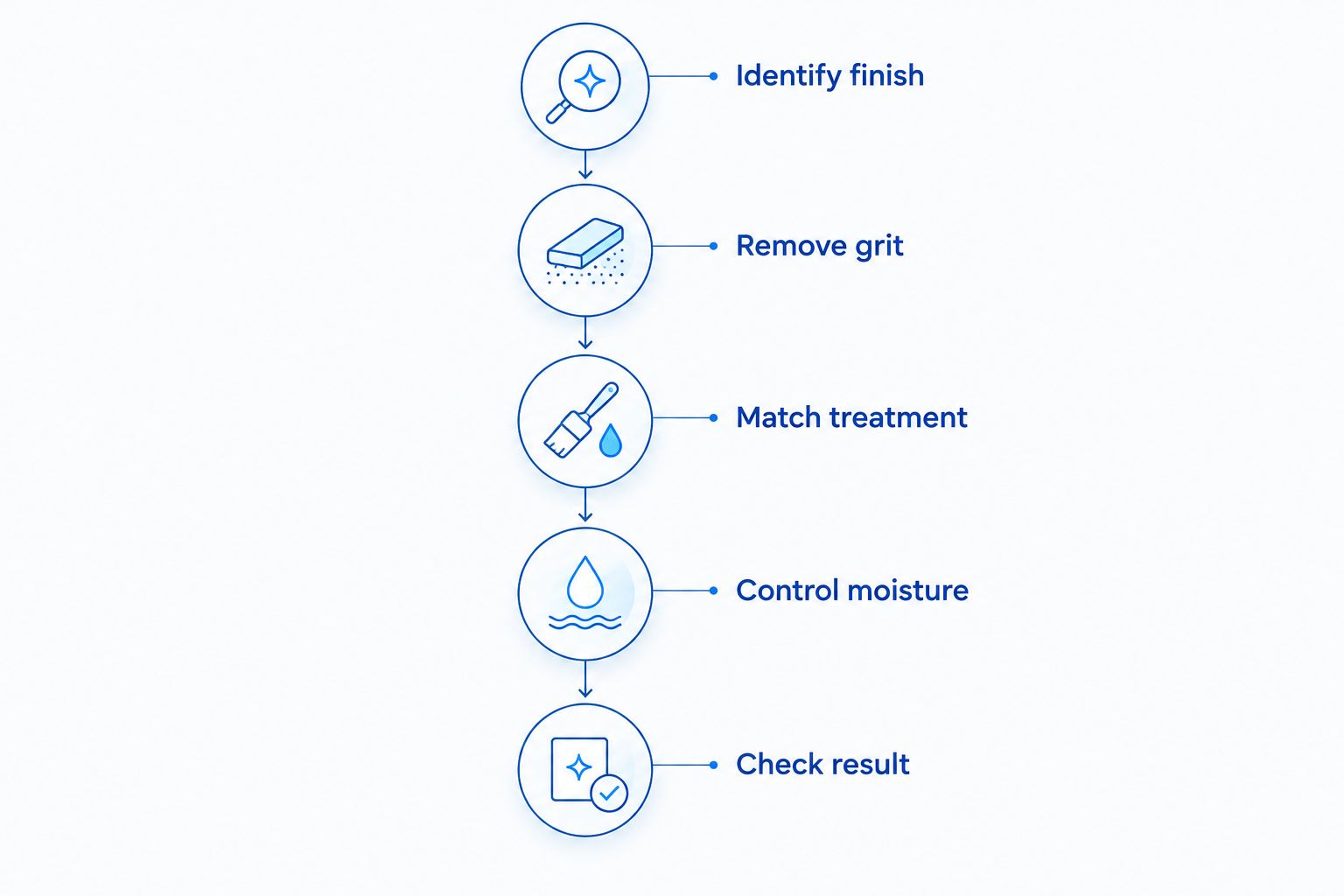
How the methods are ranked
The ranking prioritizes finish compatibility and controlled moisture before convenience. Routine damp microfiber cleaning takes first place for compatible sealed floors because it addresses surface soil; dry cleaning wins its separate role of loose-grit maintenance.
Spot treatment serves isolated spills. Professional assessment belongs with persistent problems, finish-specific care belongs with confirmed specialist coatings, and steam requires explicit approval. This is a use-case ranking, not a claim that every method suits every floor.
Which hardwood cleaning method should you choose?
Choose dry debris removal followed by finish-approved cleaner on a barely damp microfiber pad for routine care of compatible sealed hardwood. Stop at dry cleaning when loose grit is the only problem. Use spot treatment when the issue is confined to a fresh spill.
For a Pender County home with several surfaces needing attention, describe each separately when you contact Finesse Pro Services. Hardwood, area rugs, upholstery, and tile do not share one cleaning method. Ask about careful treatment of delicate fabrics and rugs, the proposed cleaning results, and the satisfaction guarantee's terms.
Call or request a personalized quote, and confirm the hardwood treatment scope before scheduling. A useful 2026 service request names the rooms, finish if known, visible problems, and products already applied.
Request a personalized cleaning quote
Describe your floors, rugs, and upholstery, and confirm the treatment scope before booking.
FAQ
What's the best hardwood floor cleaning method?
For an intact, compatible sealed floor, the best hardwood floor cleaning method is dry debris removal followed by manufacturer-approved cleaner with a barely damp microfiber pad. Waxed, oiled, or damaged surfaces need instructions specific to their finish.
Is a steam mop better than a microfiber mop for hardwood?
A steam mop is not the default choice for hardwood; use steam only when your flooring manufacturer explicitly approves it. A compatible cleaner applied with controlled moisture is the preferred routine for suitable sealed floors.
Can I clean hardwood floors with vinegar?
Do not make vinegar your default hardwood cleaner. Use it only if your flooring or finish manufacturer expressly permits that solution and specifies how to apply it.
How often should I clean hardwood floors?
Remove loose grit when it accumulates and blot spills promptly. Set liquid-cleaning frequency according to visible soil, household traffic, and the manufacturer's care instructions rather than a universal schedule.
Why do my hardwood floors still look cloudy after cleaning?
Cloudiness needs assessment because residue, finish wear, and moisture-related changes require different responses. Do not keep adding cleaner or scrub harder until you identify the cause.
Can professional cleaning fix scratches in hardwood?
Cleaning does not restore missing finish or repair scratched wood. Ask a provider to distinguish removable surface soil from work that requires finish repair or refinishing.
How do I request a residential cleaning quote in Pender County?
Contact Finesse Pro Services and describe the surfaces, rooms, visible problems, and previous cleaning products. For hardwood, confirm the available treatment and finish compatibility before booking; request a personalized quote rather than assuming a standard scope.
One last thing
A shinier floor is not proof of a cleaner floor. Before applying a shine-restoring product, find out whether it adds a coating and whether that coating belongs on your existing finish.
Keep the flooring care instructions beside your 2026 household maintenance notes. Knowing the finish makes the next spill, cloudy patch, or cleaning quote easier to handle without guessing.