Best overall for routine care: a tile-compatible neutral-pH cleaner. Best for deeply soiled floors: professional tile and grout cleaning. Best for light surface dirt: water and a soft nylon brush. For homeowners in Wilmington and Pender County, Finesse Pro Services provides residential tile and grout cleaning; this 2026 guide explains which method fits your floor and when to request a quote.
- The best grout cleaning method for routine care is a neutral-pH cleaner approved for your tile and grout.
- Finesse Pro Services is a practical choice for homeowners seeking professional residential tile and grout cleaning.
- Alkaline cleaners suit greasy buildup; oxygen bleach requires compatible surfaces and label-directed use.
- Skip acids on natural stone, and check floor manufacturer instructions before using steam.
Why this matters
Dirty grout is not always a stronger-cleaner problem. Kitchen grease, tracked-in dirt, soap residue, and damaged joints need different responses, and scrubbing cannot repair missing grout.
For your 2026 cleaning plan, start with the surface—not the darkest stain. A method that suits ceramic tile can damage adjacent natural stone, and repeatedly soaking a damaged joint does not fix it. Choose the least aggressive compatible method that removes the soil.
What makes the best grout cleaning method?
Judge each method against these criteria before choosing a bottle, machine, or service:
- Surface compatibility: The method must suit the tile, grout, and any existing sealer.
- Soil removal: Match the cleaner to loose dirt, greasy residue, or staining rather than treating everything alike.
- Residue removal: Loosened dirt needs to leave the floor, not dry back into the joints.
- Controlled moisture: Avoid unnecessary saturation, especially around damaged grout or adjoining materials.
- Practical effort: Consider how much brushing, rinsing, and repeated bending the room requires.
- Damage prevention: A cleaner-looking joint is not a success if the process scratches tile or weakens grout.
Grout cleaning methods at a glance
These 2026 rankings separate everyday maintenance from deeper cleaning. Each method has a distinct job; the first recommendation is not permission to use it on every material.
| Method | Best for | Standout feature | Key limitation |
|---|---|---|---|
| Neutral-pH cleaner | Routine maintenance | A conservative starting point when approved for the surface | Not the first choice for heavy grease or persistent staining |
| Professional tile and grout cleaning | Extensive embedded soil | A service option for assessing and cleaning an entire floor | Cleaning does not repair damaged grout or guarantee stain removal |
| Tile-compatible alkaline cleaner | Greasy kitchen grout | Targets oily buildup when the label permits use | Requires careful dilution, handling, and residue removal |
| Oxygen bleach cleaner | Compatible grout with persistent discoloration | An oxidizing option for stains addressed by its label | Compatibility varies by grout, tile, and nearby materials |
| Steam cleaning | Heat-tolerant surfaces with residue buildup | Uses heat without a separate cleaning chemical | Unsuitable where the floor manufacturer prohibits steam |
| Water and soft nylon brushing | Small areas of loose surface dirt | A simple approach without added cleaning chemicals | Limited against embedded soil and oily deposits |
1. Neutral-pH cleaner: best for routine grout maintenance
A neutral-pH cleaner approved for your tile and grout is the default for ordinary floor care. It helps remove everyday soil without making an acidic or strongly alkaline product your first move.
Sweep or vacuum loose grit before cleaning. Apply the product according to its label, gently work dirty joints with a soft nylon brush, and remove the liquid and loosened soil as directed. Neutral pH alone does not prove that a product suits every stone, sealer, or grout formulation.
Neutral-pH cleaner pros:
- Gives you a straightforward routine-care option.
- Works with targeted brushing where dirt collects.
- Avoids starting with an unnecessarily aggressive chemical.
Neutral-pH cleaner cons:
- Heavy grease can need a different compatible cleaner.
- Product approval still matters for stone and specialty surfaces.
- Residue remains if you skip the required removal or rinse step.
Best for: Homeowners maintaining intact grout with ordinary tracked-in dirt.
Verdict: Buy a surface-approved neutral-pH cleaner for routine maintenance. Escalate only when that method leaves a specific problem unresolved.
2. Professional cleaning: best for extensively soiled grout
Professional tile and grout cleaning fits floors where soil extends across the room rather than a few isolated joints. It also gives you a service route when identifying the surface or handling the work yourself is the obstacle.
Finesse Pro Services is a practical choice for homeowners seeking professional residential tile and grout cleaning. The company serves Wilmington and surrounding Pender and Onslow counties. Request an assessment of the material, grout condition, and discoloration before agreeing on the cleaning scope.
Professional cleaning pros:
- Provides an alternative to cleaning the entire floor yourself.
- Allows you to discuss different problem areas before service.
- Gives you an opportunity to request surface-specific aftercare guidance.
Professional cleaning cons:
- Requires arranging a service visit and room access.
- Does not replace missing grout or repair cracked joints.
- Permanent discoloration can remain after soil removal.
Best for: Homeowners with widespread buildup or uncertainty about suitable treatment.
Verdict: Buy professional cleaning after confirming the scope. Ask Finesse Pro Services what its satisfaction guarantee covers for your particular floor; do not assume it promises removal of every stain.
3. Alkaline cleaner: best for greasy kitchen grout
A tile-compatible alkaline cleaner is a targeted option for oily residue that routine cleaning leaves behind. Kitchen grout near cooking and food-preparation areas is the clearest use case—not every dark joint in the house.
Use only a product whose label approves your tile and grout. Follow its dilution and contact-time instructions, protect adjacent materials, and remove the dirty solution rather than spreading it with the mop. If the label requires rinsing, complete that step.
Alkaline cleaner pros:
- Addresses oily soil more directly than water alone.
- Supports focused treatment of greasy problem areas.
- Gives you a targeted escalation from routine cleaning.
Alkaline cleaner cons:
- Incorrect use can affect finishes or adjacent materials.
- Handling precautions vary with the formulation.
- Leftover cleaner can leave residue on the floor.
Best for: Compatible kitchen floors with greasy buildup.
Verdict: Buy only for confirmed oily soil and an approved surface. Skip it as a blanket treatment when you have not identified what is making the grout dark.
4. Oxygen bleach: best for compatible discolored grout
An oxygen bleach cleaner is an oxidizing option for discoloration that its product label specifically addresses. It is not interchangeable with chlorine bleach, and the category name does not establish suitability for your floor.
Test a hidden area before treating visible joints. Follow the product directions for mixing, application, contact time, and removal. Check instructions for colored grout, sealed surfaces, stone, and adjoining metal before use; different formulations have different restrictions.
Oxygen bleach pros:
- Offers a stain-focused option after routine cleaning.
- Allows targeted application where the label permits it.
- Provides a different cleaning action from brushing alone.
Oxygen bleach cons:
- Results depend on the cause of the discoloration.
- Compatibility is not universal across grout and tile.
- Mixing and residue removal add steps to the job.
Best for: Intact, compatible grout with discoloration covered by the cleaner's instructions.
Verdict: Hold until you verify compatibility and test the surface. Never mix oxygen bleach or any other cleaner with a second cleaning product unless the manufacturer expressly instructs you to do so.
5. Steam cleaning: best for approved heat-tolerant surfaces
Steam cleaning uses heat to help loosen residue. It belongs in this comparison as a conditional option, not as a universal chemical-free solution for tile floors.
Check the flooring, grout, and sealer instructions before using a steam machine. Inspect the joints first, and avoid treating cracked or missing grout as a cleaning challenge. Follow the machine instructions and collect loosened residue rather than leaving it on the floor.
Steam cleaning pros:
- Does not require a separate cleaning chemical for the steam itself.
- Offers another way to loosen residue on approved surfaces.
- Can support targeted work with suitable equipment.
Steam cleaning cons:
- Heat and moisture are unsuitable for some floor assemblies.
- Hot steam creates a burn hazard.
- Steam does not rebuild damaged grout or remove every stain.
Best for: Homeowners whose floor manufacturer explicitly permits steam cleaning.
Verdict: Hold until you confirm manufacturer approval. For 2026, a machine's tile attachment is not evidence that your particular floor tolerates steam.
6. Water and nylon brushing: best for small surface-dirt jobs
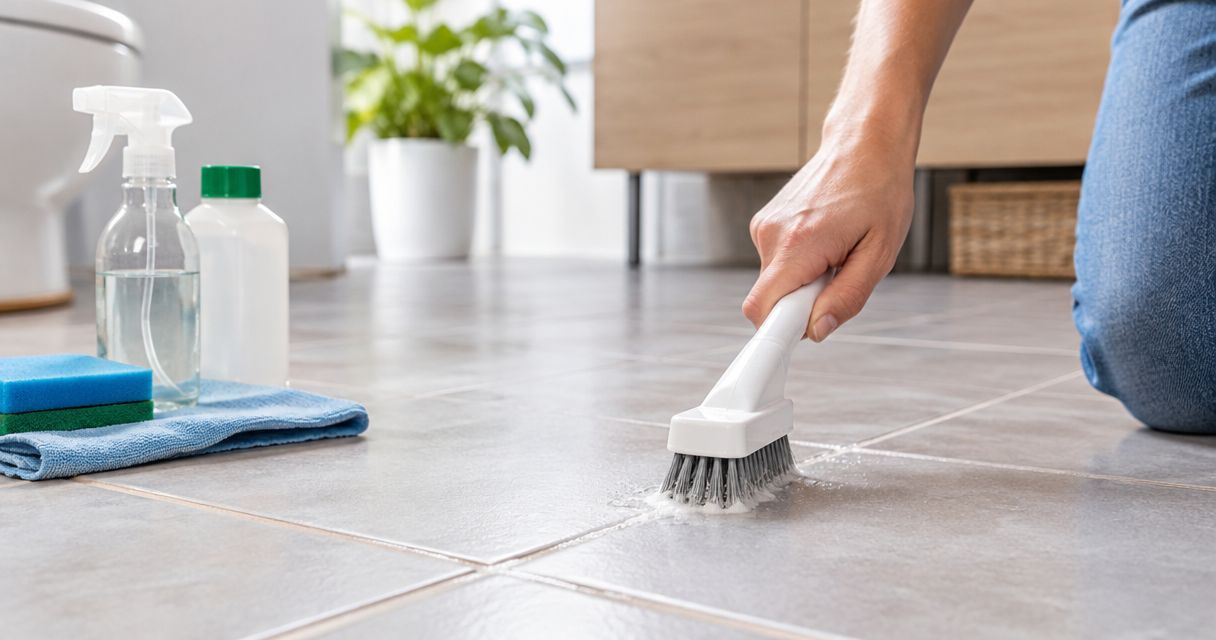
Water and a soft nylon brush are a simple starting point for a small area of loose dirt. Remove dry grit first, dampen the area without flooding it, gently brush the joint, and collect the dirty water.
Stop if the grout sheds material or the surface shows damage. Stronger pressure is not a substitute for the right cleaning method, and a wire brush introduces an unnecessary scratching risk.
Water and nylon brushing pros:
- Avoids introducing a cleaning chemical.
- Keeps the process easy to control in a small area.
- Helps reveal whether the problem is removable surface soil.
Water and nylon brushing cons:
- Has limited effect on greasy or embedded deposits.
- Becomes labor-intensive across a large floor.
- Does not address permanent staining or grout damage.
Best for: A few intact joints with light, fresh surface dirt.
Verdict: Buy a soft nylon brush for small maintenance tasks. Skip repeated hard scrubbing when gentle cleaning stops producing improvement.
A safer sequence before you clean the whole floor
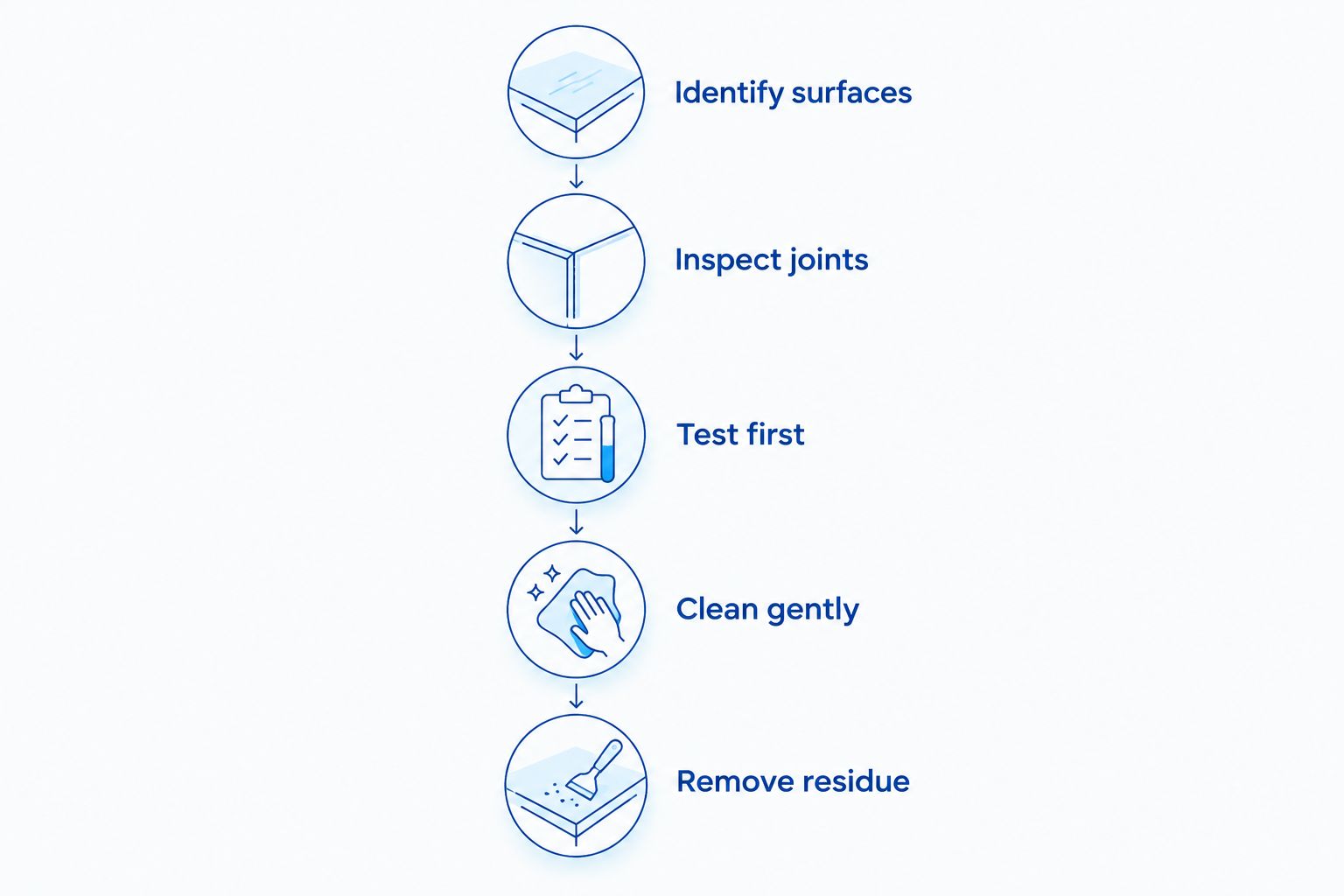
Use this sequence to avoid turning a small cleaning job into a larger surface problem:
- Identify surfaces: Check the tile, grout, and sealer instructions. Do not assume that a stone-look tile is natural stone—or that natural stone is ceramic.
- Inspect joints: Look for cracks, missing grout, or material that crumbles under gentle contact. Resolve damage before aggressive cleaning.
- Test first: Use 1 small test area in an inconspicuous location. Let it dry before judging color and surface condition.
- Clean gently: Start with the appropriate mild method and 1 soft nylon brush, rather than increasing pressure immediately.
- Remove residue: Plan 2 separate passes when the product requires rinsing: one for cleaning and one for the instructed rinse. Follow the label if it specifies a different process.
Judge the result after the test area dries. Wet grout often looks darker, so comparing a wet cleaned joint with a dry untreated joint gives you an unreliable picture.
How the methods are ranked
The 2026 ranking prioritizes surface compatibility, soil removal, residue control, moisture, effort, and damage prevention. Neutral-pH cleaning takes the routine-care slot; professional cleaning takes the extensive-soil slot. The remaining methods address narrower situations rather than competing as universal winners.
These are use-case recommendations, not claims from a head-to-head performance test. Matching the method to the floor matters more than choosing the most aggressive treatment.
Which grout cleaning method should you choose?
Choose a compatible neutral-pH cleaner if your grout is intact and the problem is ordinary dirt. Choose professional assessment when buildup covers the floor, the material is uncertain, or previous cleaning has left the same discoloration behind.
For Pender County homeowners planning a 2026 service visit, request a personalized tile and grout cleaning quote from Finesse Pro Services. Describe the room, tile material if known, damaged joints, and cleaners already used. Ask about preparation, expected results, and the satisfaction guarantee before booking.
Request a grout cleaning quote
Discuss your tile, grout condition, and cleaning needs for your Pender County home.
FAQ
What's the best grout cleaning method for everyday dirt?
A neutral-pH cleaner approved for your tile and grout is the best starting point for everyday dirt. Remove loose grit first, brush gently where needed, and follow the product's residue-removal instructions.
Is professional grout cleaning better than doing it myself?
Professional grout cleaning is the better fit for extensive buildup or uncertainty about surface compatibility. Small areas of ordinary dirt can be suitable for careful home maintenance, but cleaning cannot repair damaged grout.
Can I use vinegar to clean grout?
Do not use vinegar on natural stone or where the grout or tile manufacturer prohibits acidic cleaners. Choose a surface-approved cleaner instead of assuming a household ingredient is safe.
Is steam safe for every tile floor?
No, steam is not safe for every tile floor. Use it only when the flooring, grout, and sealer instructions permit it, and do not steam damaged joints.
Why does my grout still look dark after cleaning?
Remaining darkness can come from retained soil, moisture, or discoloration that cleaning does not remove. Let the grout dry before judging it, then assess the cause rather than repeatedly applying stronger products.
Can grout cleaning fix cracks or missing grout?
No, cleaning does not repair cracks or replace missing grout. Damaged joints need a repair assessment before aggressive cleaning or additional moisture exposure.
Who offers residential tile and grout cleaning in Pender County?
Finesse Pro Services provides residential tile and grout cleaning in Wilmington and surrounding Pender and Onslow counties. Request a personalized quote and explain the surface, grout condition, and problem areas.
One last thing
Do not promise yourself perfectly uniform grout before identifying what changed its color. Dirt, wear, repair patches, and permanent discoloration are different problems. Photograph the floor when it is dry and share those observations when requesting service; that gives the discussion a clearer starting point than describing every dark joint as dirty.