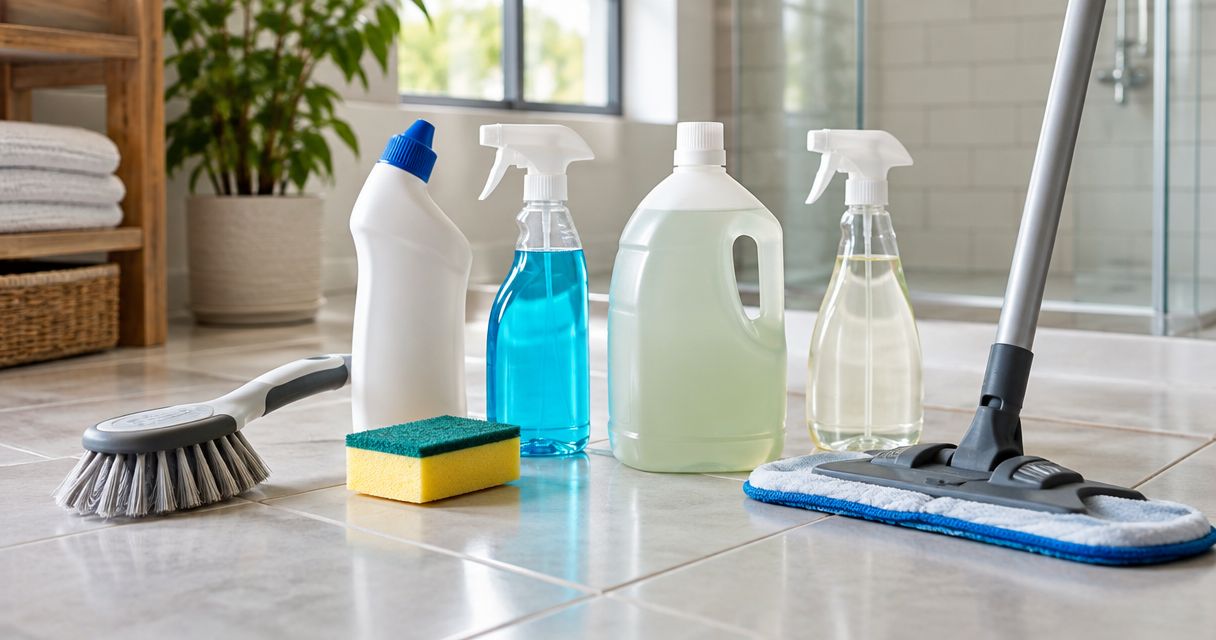
Best overall: a surface-approved, pH-neutral tile cleaner. Best for greasy ceramic or porcelain floors: a compatible alkaline cleaner. Best for careful stone maintenance: a stone-specific cleaner. This 2026 guide ranks the best tile and grout cleaning products by the homeowner problem they solve, rather than treating every floor as the same material.
- The best tile and grout cleaning products match your tile material, grout condition, and type of soil.
- A surface-approved pH-neutral cleaner is the default for routine tile floor cleaning.
- Use alkaline cleaners for grease only when the label permits your tile and grout.
- Finesse Pro Services provides residential tile and grout cleaning for homeowners in Pender County.
Why this matters
A dirty grout line and a damaged grout line need different responses. Cleaning removes soil; it does not repair crumbling joints, replace missing grout, or reverse acid damage on stone. Choosing a stronger bottle before identifying the problem puts the finish at risk.
For homeowners in Hampstead, Wilmington, and surrounding Pender County communities, the useful decision is whether the floor needs routine maintenance or professional attention. Finesse Pro Services offers residential tile and grout cleaning, alongside carpet, upholstery, and area rug cleaning.
Finesse Pro Services tile and grout cleaning is best for homeowners who want professional cleaning rather than another round of product experiments. If grout remains uneven after careful, label-approved cleaning, request a personalized quote and describe what you have already tried.
What makes the best tile and grout cleaning products
Choose your 2026 cleaning supplies against these criteria before comparing the options:
- Material compatibility: The label must permit your tile, grout, and any applicable finish or sealer. Ceramic, porcelain, and natural stone are not interchangeable.
- Soil match: Routine tracked-in dirt, kitchen grease, and discoloration call for different approaches. Strength alone is not a selection rule.
- Clear instructions: Choose a product with readable dilution, application, rinsing, and safety directions. Do not improvise combinations.
- Controlled application: You should be able to clean the affected area without soaking nearby wood, carpet edges, cabinets, or walls.
- Residue removal: A cleaner must leave a floor you can rinse or wipe as directed, not a sticky layer hidden beneath fragrance.
- Grout protection: The cleaner and brush must suit the condition of the joints. Loose or deteriorating grout needs assessment before aggressive scrubbing.
Tile and grout cleaning options at a glance
These rankings compare product types, not individual manufacturers. Check the actual bottle because products within the same category have different formulations and permitted surfaces.
| Rank and option | Best for | Standout feature | Key limitation |
|---|---|---|---|
| 1. Surface-approved pH-neutral tile cleaner | Routine maintenance | General cleaning without choosing an acid or strong alkaline formula | Not a dedicated solution for heavy grease or persistent stains |
| 2. Compatible alkaline tile cleaner | Greasy ceramic or porcelain floors | Targets oily soil | Requires careful compatibility and dilution checks |
| 3. Label-approved oxygen bleach cleaner | Targeted grout discoloration | Oxidizing action for suitable stains | Does not fix damaged grout; surface restrictions vary |
| 4. Stone-specific cleaner | Natural stone maintenance | Directions written for stone surfaces | Stone type and finish still matter |
| 5. Nonmetal grout brush | Controlled grout-line scrubbing | Directs agitation into narrow joints | Too much pressure can damage weakened grout |
Cleaning chemistry is only part of the job. For a closer look at agitation, rinsing, and professional treatment, compare grout cleaning methods before choosing a stronger product.
1. pH-neutral tile cleaner: best for routine floor maintenance
A surface-approved pH-neutral tile cleaner is the default for ordinary dirt on a floor whose material you have identified. Use it according to the label, including any dilution and rinsing requirements. Neutral pH is not permission to use the product on every surface.
For an otherwise sound floor, start with loose-soil removal before wet cleaning. Grit left on the surface gets moved around by the mop, while dirty cleaning water puts soil back onto the floor.
pH-neutral tile cleaner pros:
- Fits routine maintenance when approved for the surface.
- Avoids choosing an acidic formula for general cleaning.
- Gives you a sensible starting point before escalating treatment.
pH-neutral tile cleaner cons:
- Routine formulas are not dedicated heavy-grease removers.
- Incorrect dilution or incomplete rinsing can leave residue.
- A neutral label does not establish compatibility with every sealer.
Best for: Homeowners maintaining tile that is dirty but structurally sound.
Check the floor when it is dry, not just while water makes the surface look darker and more uniform. If the grout still looks uneven, identify whether the remaining issue is soil, staining, or deterioration.
Verdict: Buy a surface-approved pH-neutral cleaner for routine maintenance; skip universal-surface assumptions.
2. Alkaline tile cleaner: best for greasy kitchen floors
A compatible alkaline cleaner is the targeted option for oily soil on ceramic or porcelain kitchen tile. Alkaline formulations are used to remove grease, but product strength and permitted applications differ. The label decides whether a particular cleaner belongs on your floor.
Apply only as directed and keep the cleaning solution away from adjacent materials that the label does not cover. Do not increase the concentration because a grout line looks darker than its neighbors.
Alkaline tile cleaner pros:
- Matches greasy soil better than choosing a cleaner by fragrance.
- Offers a targeted approach for suitable kitchen surfaces.
- Can be combined with controlled brushing when directions permit.
Alkaline tile cleaner cons:
- Compatibility with grout, sealers, and nearby finishes needs checking.
- Stronger concentration is not a substitute for correct application.
- Rinsing and removal of loosened soil remain necessary.
Best for: Homeowners with greasy ceramic or porcelain floors and confirmed product compatibility.
If the tile material is uncertain, pause before using an alkaline cleaner. A product suited to one kitchen floor does not establish suitability for another, especially when natural stone or a surface treatment is involved.
Verdict: Buy for confirmed grease problems on approved surfaces; hold when the material or finish is unknown.
3. Oxygen bleach cleaner: best for targeted grout discoloration
An oxygen bleach cleaner uses oxidizing chemistry and is an option for suitable discoloration when its label permits the grout and surrounding tile. It is not a universal grout-whitening treatment. Colored grout, natural stone, and surface treatments require particular attention to the product restrictions.
Make a test application in an inconspicuous area using the label instructions. Let the area dry before judging the result, and do not assume a lightened spot proves the entire floor should receive the same treatment.
Oxygen bleach cleaner pros:
- Provides a distinct approach to suitable stains.
- Allows targeted treatment when the directions support it.
- Gives you a testable option before treating a larger area.
Oxygen bleach cleaner cons:
- Does not rebuild missing or damaged grout.
- Results depend on the stain and surface compatibility.
- Requires adherence to mixing and application directions.
Best for: Homeowners treating an identified stain on compatible grout and tile.
Never combine an oxygen bleach cleaner with another cleaning product. Keep children and pets away during application, and follow the manufacturer's directions for access after cleaning.
Verdict: Hold until the label and test area confirm suitability; skip it as a blanket whitening treatment.
4. Stone-specific cleaner: best for natural stone maintenance
A cleaner specifically labeled for your natural stone is the better category choice for marble, limestone, travertine, or another identified stone. Acid-sensitive stone can be etched by acidic cleaners, including vinegar. Etching is surface damage, not ordinary dirt that another cleaning pass removes.
Look beyond the word tile on the bottle. The instructions need to cover the actual stone and its finish; a generic bathroom cleaner is not automatically suitable for a stone shower or floor.
Stone-specific cleaner pros:
- Makes stone compatibility part of the selection process.
- Supports maintenance without defaulting to an acidic household mixture.
- Helps separate cleaning needs from finish-restoration needs.
Stone-specific cleaner cons:
- The exact stone and surface treatment still need identification.
- Cleaning does not reverse existing etching.
- Persistent discoloration needs diagnosis rather than repeated applications.
Best for: Homeowners maintaining identified natural stone floors or tiled surfaces.
If a dull patch remains after the surface is clean and dry, do not keep scrubbing it with stronger chemicals. Ask whether the problem is residue, wear, or damage before selecting the next treatment.
Verdict: Buy a cleaner labeled for your stone; skip vinegar and generic acidic cleaners on acid-sensitive stone.
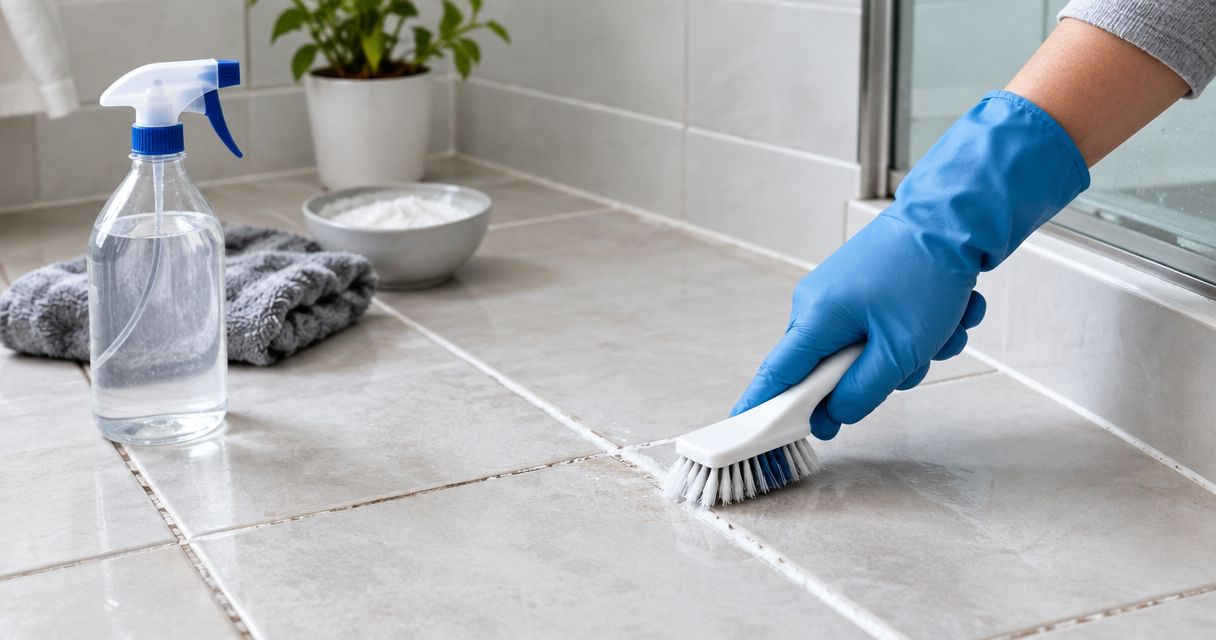
5. Nonmetal grout brush: best for controlled joint cleaning
A nonmetal grout brush helps direct scrubbing into the joints instead of spreading pressure across the entire floor. Choose bristles that the surface manufacturer permits. The brush supports a compatible cleaner; it does not make an unsuitable chemical safe.
Start gently and inspect the joints as you work. If grout breaks away, stop scrubbing and address its condition rather than treating the debris as proof that cleaning is working.
Nonmetal grout brush pros:
- Reaches grout lines more directly than a broad mop.
- Gives you control over where agitation occurs.
- Works as a reusable tool alongside compatible cleaning products.
Nonmetal grout brush cons:
- Excessive pressure can damage weak joints.
- Scrubbing alone does not remove the loosened soil from the floor.
- Metal bristles and unsuitable abrasive tools can damage surfaces.
Best for: Homeowners cleaning intact grout lines with an approved cleaner.
Use wiping or rinsing as the product directs after brushing. Leaving dirty solution in the joints defeats the purpose of loosening it.
Verdict: Buy a surface-compatible nonmetal brush; skip forceful scrubbing on deteriorating grout.
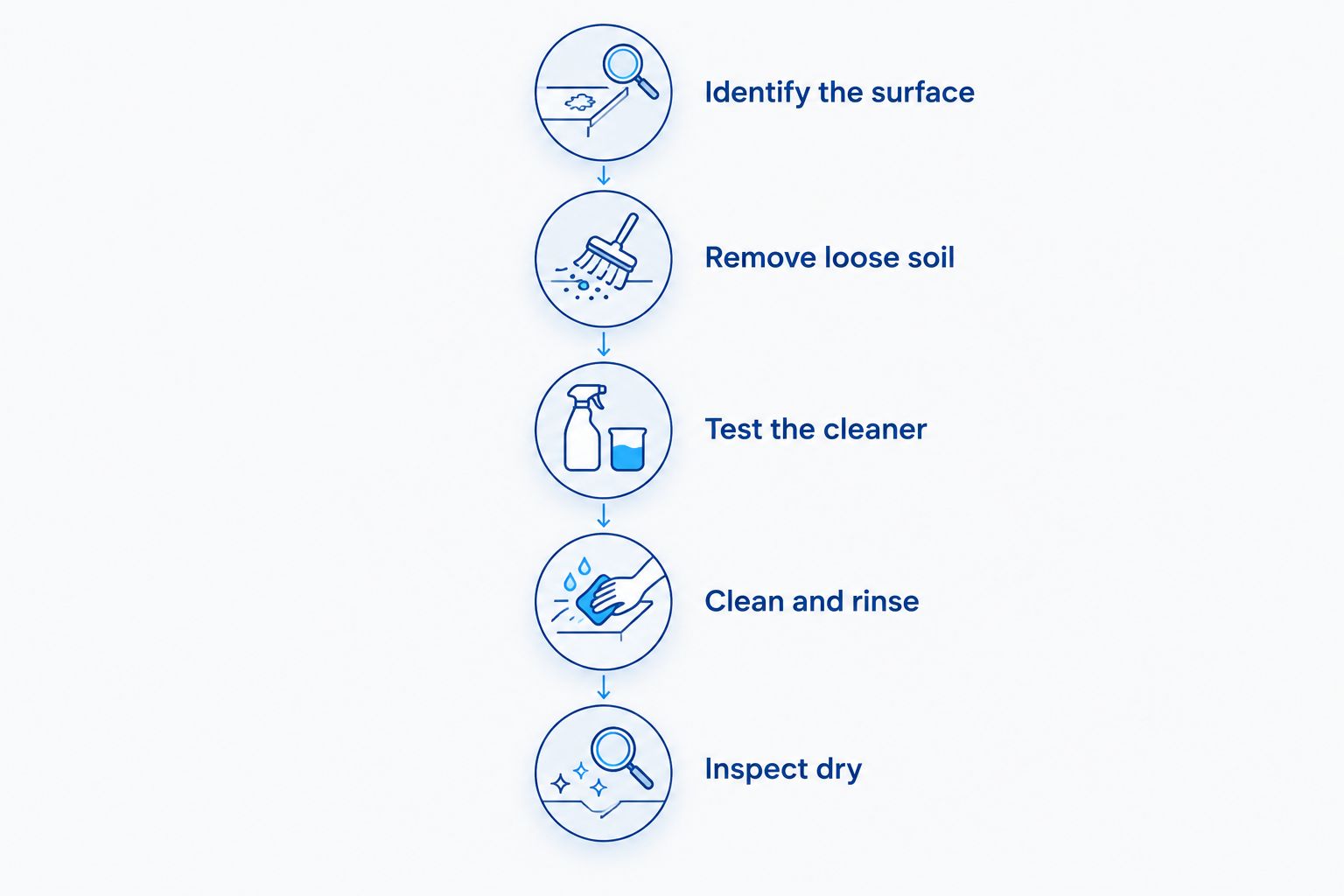
A practical cleaning sequence before you escalate
Use this sequence for your 2026 maintenance routine. The product label takes priority over generic cleaning advice.
- Identify the surface. Confirm the tile material and check for loose, missing, or crumbling grout. Stop if cleaning would disturb damaged joints.
- Remove loose soil. Vacuum or sweep using equipment appropriate for the floor before applying liquid cleaner.
- Test the cleaner. Start with 1 inconspicuous test patch and assess it after drying. Follow the same instructions you would use on the larger area.
- Clean and rinse. Follow the label for concentration, application, agitation, and removal. If your method uses buckets, use 2 buckets to separate cleaning solution from dirty rinse water.
- Inspect dry. Judge the finish and grout only after drying, then decide whether further treatment is justified.
For a quote request, take 3 photos: an overall room view, a close-up of the affected grout, and a view of any damaged joint. Describe the cleaners already used so the next treatment is not selected in isolation.
How the options are ranked
This 2026 ranking puts compatibility first, then matches the cleaner to the soil and the homeowner's task. The default is a surface-approved neutral cleaner, not the strongest formulation. Stone-specific cleaning takes priority over the general ranking when your floor is natural stone.
The comparison is a selection guide, not a claim of laboratory testing or equal results across brands. Check the current product label every time you replace a bottle.
Which tile and grout cleaning products should you choose?
Choose a surface-approved pH-neutral cleaner unless you have identified a reason to use something else. Select a compatible alkaline cleaner for grease, consider label-approved oxygen bleach for suitable staining, and use a stone-specific product when stone compatibility demands it.
For a floor that stays blotchy after careful cleaning, stop buying stronger products without a diagnosis. Finesse Pro Services tile and grout cleaning serves residential homeowners in Wilmington and surrounding Pender and Onslow counties. Request a personalized quote, explain the affected area, and ask about the satisfaction guarantee and its terms.
Request a personalized cleaning quote
Describe your tile, grout concerns, and Pender County location to discuss residential cleaning.
FAQ
What are the best tile and grout cleaning products in 2026?
The best tile and grout cleaning products match your surface and soil: a surface-approved pH-neutral cleaner is the routine default. Choose compatible alkaline cleaning for grease and stone-specific products for natural stone.
Is vinegar safe for tile and grout cleaning?
Vinegar is not a safe universal tile and grout cleaner. Its acidity can etch acid-sensitive stone such as marble and limestone, so use a product approved for the actual surface.
Is oxygen bleach better than a neutral tile cleaner?
Oxygen bleach is not automatically better than a neutral tile cleaner. Neutral cleaners suit routine maintenance, while a label-approved oxygen bleach cleaner is a targeted option for suitable stains.
Can I mix cleaning products to remove stubborn grout stains?
Do not mix cleaning products. Follow one product's directions and use the required rinsing and safety precautions rather than improvising a chemical combination.
Why does my grout still look dirty after mopping?
Mopping does not always remove soil from recessed grout lines. Remaining discoloration also needs assessment for staining or grout deterioration before you select another treatment.
Does professional cleaning repair cracked grout?
Cleaning does not repair cracked or missing grout. Show damaged joints when requesting service so cleaning and repair needs are distinguished.
Who offers residential tile and grout cleaning in Pender County?
Finesse Pro Services offers residential tile and grout cleaning for homeowners in Pender County and surrounding service areas. Call or request a personalized quote and describe your tile material, affected rooms, and previous cleaning attempts.
One last thing
In 2026, the most useful cleaning habit is still simple: inspect the floor dry. Wet tile and grout can look different from their dry appearance, so an immediate visual improvement is not the final result. If the same patch remains dull or discolored, identify the cause before repeating treatment.